| |
Effective October 18, 2010 the U.S. Commodity
Futures Trading Commission (CFTC)
will implement the first final rule of the Dodd-Frank Wall Street
Reform and Consumer Protection Act.
848 page PDF (FINReg, 2010)
For USA citizens, this will effectively prohibit access to offshore retail forex
accounts.
Title XIII of the Food, Conservation and Energy Act of 2008 (the
Farm Bill) reauthorizes the CFTC to regulate retail forex and make
the rules that trading will be subject to.
Regarding a U.S. citizen trading at any U.S. FCM
such as: (Gain Capital, FXCM, FXDD, Alpari) and any of their off
shore entities such as Gain UK, FXCM UK FXDD Malta etc... On October
18, 2010 if your account is traded at any of these brokers, it will be
closed and you will be asked to fill out new forms. You will be
mandated by your broker to trade Forex at the U.S. locations of any
off shore broker. Highlights of the new U.S. rules:
NEW RULES EFFECTIVE OCTOBER 18, 2010 for U.S. RESIDENTS
ONLY
-
50:1 margin on most FX pairs including the four U.S. crosses Euro/USD, GBP/USD,
USD/JPY and USD/CHF
-
20:1 margin on most FX exotics including all other pairs offered i.e. GBP/JPY etc (These margin levels can be reduced at any
time by the CFTC)
-
NO HEDGING of positions will be allowed. Currently
if you are at an off shore entity you can hedge
-
FIRST IN FIRST OUT.(FIFO) If you have multiple
positions on a pair you must close them out in order
which they were opened
-
No Spot Gold and Silver
-
No Foreign Banks or Off-Shore FX Brokers
-
Most retail OTC forex transactions are banned,
pursuant to Section 742(c) of the Act
-
"...A person ... shall not offer to,
or enter into with, a person that is
not an eligible contract
participant, any agreement,
contract, or transaction in
foreign currency except
pursuant to a rule or regulation of
a Federal regulatory agency allowing
the agreement, contract, or
transaction under such terms and
conditions as the Federal regulatory
agency shall prescribe..."
RULES IN EFFECT PRIOR TO OCTOBER 18, 2010 for U.S. RESIDENTS
-
100:1 MARGIN ON ALL PAIRS. This means that you now
receive $10.00 per pip for every standard lot you
trade. Some of you trade at 200:1 margin which gives
you an even higher payoff when you have a winning
trade.
-
HEDGING. If you trade at off shore entities you may
hedge positions
-
FIRST IN FIRST OUT. If you are trading off shore
you may close any of your positions in any order you
please
PRACTICAL EFFECT OF THE CHANGES
-
On Oct 18 2010 you will receive from $2.00 to $5.00
for every pip traded depending on the pair. You
will need up to 5 times the amount of money to do
the same transactions you conduct today
-
HEDGING. You will not be able to use any Hedging
strategies moving forward
-
FIRST IN FIRST OUT. You will no longer be able to
choose the order in which you can close your trades.
THESE FOLLOWING ARE MOSTLY FULLY IN EFFECT NO
LATER THAN July 15, 2011 for U.S. RESIDENTS
-
Elimination of OTC Forex:
Effective 90 days from its inception, the Dodd-Frank
Act bans most retail OTC forex transactions as per
section 742(C) of the Dodd-Frank Act.
- Elimination of OTC Metals:As
for OTC precious metals such as gold or silver,
Section 742(a) of the Act prohibits any person
[which again includes companies]from entering into,
or offering to enter into, a transaction in any
commodity with a person that is not an eligible
contract participant or an eligible commercial
entity, on a leveraged or margined basis.
-
Small Pool Exemption (Introducing Brokers)
Eliminated:
Pursuant to Section 403 of Act, the "private
adviser" exemption, namely Section 203(b)(3) of the
Investment Advisers Act of 1940 ("Advisers Act"),
will be eliminated within one year of the Act’s
effective date (July 21, 2011).
-
Alteration to financial qualifications:
Section 413(a) of the Act alters the financial
qualifications of who can be considered an
accredited investor, and thus a qualified as
eligible participant (“QEP”). It is important to
note that the revised accredited investor standard
only applies to new investors and does not cover
existing investors. However, additional
subscriptions from existing investors are generally
treated as requiring confirmation of continuing
investor eligibility.
- Close Accounts:
Most financial institutions have informed their U.S.
clients about the implications of the Dodd-Frank
act. However, if you still have an account, contact
your forex broker in regards to the Dodd-Frank act
and make arrangements to withdraw your funds.
- Non U.S. based non U.S.
resident traders are not necessarily
effected by the Dodd-Frank act.
- George Soros
announced that his fund is closed to outside
investors as of July 2011 and is distributing $1B in
client funds back to them. Apparently the
remaining $24.5B of family money will be used as he
deems most appropriate.
Links to some of the information found on this web page:
How to make the Sec 988 taxed as Sec 1256
election #1
How to make the Sec 988 taxed as Sec 1256
election #2 (Internal Revenue Code Sec. 988)
How to make the Sec 988 taxed as Sec 1256
election #3 (Internal Revenue Code Sec. 988)
How to make the Sec 988 taxed as Sec 1256
election #4 (Treas. Regulations §1.988-3 Requirements, Verification
and Independent Verification)
How to make the Sec 1256 taxed as Sec 988
election #5
How to make the Sec 1256 taxed as Sec 988
election #6
How to make the Sec 1256 taxed as Sec 988
election #7 (Treas. Regulations §1.988-1(a)(7) written election and
due date for making the election)
#8 How to report on your tax return
#9 Where to report on your tax return
#10 When losses exceed $50,000 - what to report on your tax return (IRS
Publication 334)
#11 When losses exceed $50,000 - what to
report on your tax return (IRS Schedule C instructions)
#12 What to report on your tax return
#13 How to report on your tax return (Notice
2003-81)
#14 Coordinated Issue Paper "Notice
2003-81" Tax Shelter
#15 IRS Notice 2003-81
#16 IRS Notice 2007-71 (Modification of
Notice 2003-81)
Summary:
Foreign Currency
Transactions,
Foreign
Exchange Markets or
FOREX have very complex tax issues.
There are
three ways private investors can trade in FOREX directly or
indirectly:
-
The spot market
(default taxation is generally under
IRC §988 for ordinary gains &
losses).
-
Forwards and futures:
- default taxation is
under
IRC §988 for ordinary gains &
losses.
- unless items
normally M2M at December 31st, in which case taxation is under
IRC §1256 for "60/40" capital gains
& losses.
-
Options:
- default taxation is
under
IRC §988 for ordinary gains &
losses.
- unless items
normally M2M at December 31st, in which case taxation is under
IRC §1256 for "60/40" capital gains
& losses.
The above defaults can
be elected out of:
-
IRC §988 items can be taxed under
IRC §1256 for "60/40" capital gains & losses if the proper election
is made.
- for certain hedge funds
defined under under §988(c)(1)(E)(iii) this results in special
§1256 "0/100" capital gains & losses.
-
IRC §1256 items can be taxed under
IRC §988 if the proper election is made.
Generally for
IRC §988 items to be taxed under IRC
§1256 the election is made before the close of the day on which such
transaction is entered into, pursuant to I RC §988(a)(1)(B) and Treas.
Reg. §1.988-3(b)(4). This can be verified as being done when
the transactions are executed in an isolated, separate brokerage
account as described under Treas. Regs 1.988-3(b)(5)(ii)(D).
Generally for
IRC §1256 items to be taxed under
IRC §988 the election is made on or before January 1st (or, if later
on or before when taxpayer holds a position) pursuant to IRC §988(c)
by the individual or by the partners of a partnership.
Character of the gain or loss
(by default):
Currency gains and losses of individuals when engaging in
business or
investment type activities are
ordinary gains and
losses. See
§988(a)(1)(A) and
§988(e).
Currency gains of individuals engaging in personal activities are capital
gains. (but pursuant to
§988(e)(2)(B)
personal currency gains per transaction that are under $200 are
generally exempt).
Currency losses of individuals engaging in personal activities are nondeductible personal expenditures. See
§165 and
§262.
§1.165-1(e) Limitation On Losses Of Individuals.
In
the case of an individual, the deduction for losses granted by
section
165(a) shall, subject to the provisions of section
165(c) and paragraph
(a) of this section, be
limited
to:
-
Losses
incurred in a trade or business;
-
Losses
incurred in any transaction entered into for profit [e.g. an
Investment], though not connected with a trade or business;
and
-
Losses of property
not connected with a trade or business and not incurred in any
transaction entered into for profit, if such losses arise from fire,
storm, shipwreck, or other casualty, or from theft, and if the loss
involved has not been allowed for estate tax purposes in the estate
tax return. For additional provisions pertaining to the
allowance of casualty and theft losses, see §§1.165-7
and 1.165-8, respectively.
Reporting (by individual taxpayers filing IRS form 1040):
Ordinary gains and losses are treated as interest income or
interest expense.
- Some taxpayers use Form
4797, Part II.
- Some taxpayers use form
1040, line 21 instead of form 4797.
- Any other appropriate place
where interest income or interest expense should be reported.
-
Net losses from a single position
that exceed $50,000
generally need to be reported on IRS form 8886 as well.
Capital Gains and Losses are
reported on Schedule D (and, if appropriate, on IRS form 6781).
If the IRC §988 election was made then the taxpayer is required to
attach a verification statement.
Pooling funds:
PAMM (Percentage Allocation Management Module or sometimes Percentage Allocation Money Management)
LAMM (Lot Allocation Management Module)
MAM (Multi-Account Management)
http://seekingalpha.com/instablog/364088-james-bibbings/469221-the-end-of-pamm-forex-allocations
http://www.interactivebrokers.com/en/p.php?f=friendsFamilyAccounts&ib_entity=ir
quotes:
http://www.marketcenter.com/forex/
Currency and
Forward Currency Contracts
Foreign currency transactions present issues related to the timing of
recognition, the character (capital or ordinary), and the source
(domestic or foreign) of the gain or loss. In 1986, Congress enacted
comprehensive tax laws concerning the treatment of foreign currency
transactions. 333 Prior to those laws, various rulings and court
decisions provided guidance as to the treatment of such transactions.
334
/Footnote/ 333 §§985-989. For a detailed discussion of foreign
currency transactions, see 184 T.M., Transactions in Stock,
Securities, and Other Financial Instruments.
/Footnote/ 334 Rev. Rul. 74-7, 1974-1 C.B. 198 (Foreign currency is
capital asset; gain or loss realized on reconversion of currency is
capital); Gillin v. U.S., 423 F.2d 309 (Ct. Cl. 1970); American Home
Prods. Corp. v. U.S., 601 F.2d 540 (Ct. Cl. 1979) (Foreign currency is
capital asset); Natl.-Standard Co. v. Comr., 80 T.C. 551 (1983), aff'd,
749 F.2d 369 (1984) (Change in value of U.S. dollars in relation to
foreign currencies produces ordinary gain or loss). United States
currency might constitute a capital asset, however, if it is not legal
tender, not in circulation, or valued in the market primarily by its
numismatic rather than its face value. See California Fed. Life Ins.
Co. v. Comr., 76 T.C. 107 (1981), aff'd, 680 F.2d 85 (9th Cir. 1982)
(U.S. Double Eagle gold coins are capital assets).
The exchange gain or loss in a foreign currency denominated
transaction arises due to a change in the exchange rate between the
booking date (the date that an asset or liability is taken into
account for U.S. tax purposes) and the date on which payment is made
or received. 345 With certain exceptions, the exchange gain or loss
is treated as ordinary income or loss. 346
/Footnote/ 345 §988(b).
/Footnote/ 346 §988(a)(1)(A).
Forward contracts for the sale of foreign currency constitute property
interests. 347 Thus, an assignment of a currency futures contract
produces capital gain or loss under general tax principles. Under the
comprehensive tax laws enacted in 1986, capital gain or loss
treatment is still available for forward contracts, future
contracts, or options in foreign currencies if the contracts or
options are otherwise capital assets, are not part of a straddle
transaction, and are identified prior to the close of the day on
which the transactions are entered into. 348
/Footnote/ 347 Carborundum Co. v. Comr., 74 T.C. 730 (1980); PLR
7847004.
/Footnote/ 348 §988(a)(1)(B).
Internal Revenue Code
Sec. 988. Treatment
Of Certain Foreign Currency Transactions
988(a) General Rule
Notwithstanding any other provisions of this chapter--
988(a)(1) Treatment As Ordinary Income Or Loss
988(a)(1)(A) In General
Except as otherwise provided in this section, any foreign currency
gain or loss attributable to a section 988 transaction shall be computed
separately and treated as ordinary income or loss (as the case
may be).
988(a)(1)(B) Special Rule For Forward Contracts, Etc.
Except as provided in regulations, a taxpayer may elect to treat
any foreign currency gain or loss attributable to a forward
contract, a futures contract, or option described in subsection (c)(1)(B)(iii)
which is a capital asset in the hands of the taxpayer and which is not a
part of a straddle (within the meaning of section 1092(c), without
regard to paragraph (4) thereof) as capital gain or loss (as the
case may be) if the taxpayer makes such election and identifies such
transaction before the close of the day on which such transaction is
entered into (or such earlier time as the Secretary may prescribe).
988(a)(2) Gain Or Loss Treated As Interest For Certain Purposes
To the extent provided in regulations, any amount treated as ordinary
income or loss under paragraph (1) shall be treated as interest income
or expense (as the case may be).
988(a)(3) Source
988(a)(3)(A) In General
Except as otherwise provided in regulations, in the case of any
amount treated as ordinary income or loss under paragraph (1) (without
regard to paragraph (1)(B)), the source of such amount shall be
determined by reference to the residence of the taxpayer or the
qualified business unit of the taxpayer on whose books the asset,
liability, or item of income or expense is properly reflected.
988(a)(3)(B) Residence
For purposes of this subpart--
988(a)(3)(B)(i) In General
The residence of any person shall be--
988(a)(3)(B)(i)(I) in the case of an individual, the country in which
such individual's tax home (as defined in section 911(d)(3)) is located,
988(a)(3)(B)(i)(II) in the case of any corporation, partnership,
trust, or estate which is a United States person (as defined in section
7701(a)(30)), the United States, and
988(a)(3)(B)(i)(III) in the case of any corporation, partnership,
trust, or estate which is not a United States person, a country other
than the United States.
If an individual does not have a tax home (as so defined), the
residence of such individual shall be the United States if such
individual is a United States citizen or a resident alien and shall be a
country other than the United States if such individual is not a United
States citizen or a resident alien.
988(a)(3)(B)(ii) Exception
In the case of a qualified business unit of any taxpayer (including
an individual), the residence of such unit shall be the country in which
the principal place of business of such qualified business unit is
located.
988(a)(3)(B)(iii) Special Rule For Partnerships
To the extent provided in regulations, in the case of a partnership,
the determination of residence shall be made at the partner level.
988(a)(3)(C) Special Rule For Certain Related Party Loans
Except to the extent provided in regulations, in the case of a loan
by a United States person or a related person to a 10-percent owned
foreign corporation which is denominated in a currency other than the
dollar and bears interest at a rate at least 10 percentage points higher
than the Federal mid-term rate (determined under section 1274(d)) at the
time such loan is entered into, the following rules shall apply:
988(a)(3)(C)(i) For purposes of section 904 only, such loan shall be
marked to market on an annual basis.
988(a)(3)(C)(ii) Any interest income earned with respect to such loan
for the taxable year shall be treated as income from sources within the
United States to the extent of any loss attributable to clause (i).
For purposes of this subparagraph, the term "related person" has the
meaning given such term by section 954(d)(3), except that such section
shall be applied by substituting "United States person" for "controlled
foreign corporation" each place such term appears.
988(a)(3)(D) 10-percent Owned Foreign Corporation
The term "10-percent owned foreign corporation" means any foreign
corporation in which the United States person owns directly or
indirectly at least 10 percent of the voting stock.
988(b) Foreign Currency Gain Or Loss
For purposes of this section--
988(b)(1) Foreign Currency Gain
The term "foreign currency gain" means any gain from a section 988
transaction to the extent such gain does not exceed gain realized by
reason of changes in exchange rates on or after the booking date and
before the payment date.
988(b)(2) Foreign Currency Loss
The term "foreign currency loss" means any loss from a section 988
transaction to the extent such loss does not exceed the loss realized by
reason of changes in exchange rates on or after the booking date and
before the payment date.
988(b)(3) Special Rule For Certain Contracts, Etc.
In the case of any section 988 transaction described in subsection
(c)(1)(B)(iii), any gain or loss from such transaction shall be treated
as foreign currency gain or loss (as the case may be).
988(c) Other Definitions
For purposes of this section--
988(c)(1) Section 988 Transaction
988(c)(1)(A) In General
The term "section 988 transaction" means any transaction described in
subparagraph (B) if the amount which the taxpayer is entitled to receive
(or is required to pay) by reason of such transaction--
988(c)(1)(A)(i) is denominated in terms of a nonfunctional currency,
or
988(c)(1)(A)(ii) is determined by reference to the value of 1 or more
nonfunctional currencies.
988(c)(1)(B) Description Of Transactions
For purposes of subparagraph (A), the following transactions are
described in this subparagraph:
988(c)(1)(B)(i) The acquisition of a debt instrument or becoming the
obligor under a debt instrument.
988(c)(1)(B)(ii) Accruing (or otherwise taking into account) for
purposes of this subtitle any item of expense or gross income or
receipts which is to be paid or received after the date on which so
accrued or taken into account.
988(c)(1)(B)(iii) Entering into or acquiring any forward contract,
futures contract, option, or similar financial instrument.
The Secretary may prescribe regulations excluding from the
application of clause (ii) any class of items the taking into account of
which is not necessary to carry out the purposes of this section by
reason of the small amounts or short periods involved, or otherwise.
988(c)(1)(C) Special Rules For Disposition Of Nonfunctional Currency
988(c)(1)(C)(i) In General
In the case of any disposition of any nonfunctional currency--
988(c)(1)(C)(i)(I) such disposition shall be treated as a section 988
transaction, and
988(c)(1)(C)(i)(II) any gain or loss from such transaction shall be
treated as foreign currency gain or loss (as the case may be).
988(c)(1)(C)(ii) Nonfunctional Currency
For purposes of this section, the term "nonfunctional currency"
includes coin or currency, and nonfunctional currency denominated demand
or time deposits or similar instruments issued by a bank or other
financial institution.
988(c)(1)(D) Exception For Certain Instruments Marked To Market
988(c)(1)(D)(i) In General
Clause (iii) of subparagraph (B) shall not apply to any regulated
futures contract or nonequity option which would be marked to market
under section 1256 if held on the last day of the taxable year.
988(c)(1)(D)(ii) Election Out
988(c)(1)(D)(ii)(I) In General
The taxpayer may elect to have clause (i) not apply to such taxpayer.
Such an election shall apply to contracts held at any time during the
taxable year for which such election is made or any succeeding taxable
year unless such election is revoked with the consent of the Secretary.
988(c)(1)(D)(ii)(II) Time For Making Election
Except as provided in regulations, an election under subclause
(I)
for any taxable year shall be made on or before the 1st day of such
taxable year (or, if later, on or before the 1st day during such year on
which the taxpayer holds a contract described in clause (i)).
988(c)(1)(D)(ii)(III) Special Rule For Partnerships, Etc.
In the case of a partnership, an election under subclause
(I) shall
be made by each partner separately. A similar rule shall apply in the
case of an S corporation.
988(c)(1)(D)(iii) Treatment Of Certain Partnerships
This subparagraph shall not apply to any income or loss of a
partnership for any taxable year if such partnership made an election
under subparagraph (E)(iii)(V) for such year or any preceding year.
988(c)(1)(E) Special Rules For Certain Funds
988(c)(1)(E)(i) In General
In the case of a qualified fund, clause (iii) of subparagraph (B)
shall not apply to any instrument which would be marked to market under
section 1256 if held on the last day of the taxable year (determined
after the application of clause (iv)).
988(c)(1)(E)(ii) Special Rule Where Electing Partnership Does Not
Qualify
If any partnership made an election under clause (iii)(V) for any
taxable year and such partnership has a net loss for such year or any
succeeding year from instruments referred to in clause (i), the rules of
clauses (i) and (iv) shall apply to any such loss year whether or not
such partnership is a qualified fund for such year.
988(c)(1)(E)(iii) Qualified Fund Defined
For purposes of this subparagraph, the term "qualified fund" means
any partnership if--
988(c)(1)(E)(iii)(I)
at all times during the taxable year (and during each preceding
taxable year to which an election under subclause (V) applied), such
partnership has at least 20 partners and no single partner owns more
than 20 percent of the interests in the capital or profits of the
partnership,
988(c)(1)(E)(iii)(II)
the principal activity of such partnership for such taxable year (and
each such preceding taxable year) consists of buying and selling
options, futures, or forwards with respect to commodities,
988(c)(1)(E)(iii)(III)
at least 90 percent of the gross income of the partnership for the
taxable year (and for each such preceding taxable year) consisted of
income or gains described in subparagraph (A), (B), or (G) of section
7704(d)(1) or gain from the sale or disposition of capital assets held
for the production of interest or dividends,
988(c)(1)(E)(iii)(IV)
no more than a de minimis amount of the gross income of the
partnership for the taxable year (and each such preceding taxable year)
was derived from buying and selling commodities, and
988(c)(1)(E)(iii)(V)
an election under this subclause applies to the taxable year.
An election under subclause (V) for any taxable year shall be made on
or before the 1st day of such taxable year (or, if later, on or before
the 1st day during such year on which the partnership holds an
instrument referred to in clause (i)). Any such election shall apply to
the taxable year for which made and all succeeding taxable years unless
revoked with the consent of the Secretary.
988(c)(1)(E)(iv) Treatment Of Certain Currency Contracts
988(c)(1)(E)(iv)(I) In General
Except as provided in regulations, in the case of a qualified fund,
any bank forward contract, any foreign currency futures contract traded
on a foreign exchange, or to the extent provided in regulations any
similar instrument, which is not otherwise a section 1256 contract shall
be treated as a section 1256 contract for purposes of section 1256.
988(c)(1)(E)(iv)(II) Gains And Losses Treated As Short-term
In the case of any instrument treated as a section 1256 contract
under subclause (I), subparagraph (A) of section 1256(a)(3) shall be
applied by substituting "100 percent" for "40 percent" (and subparagraph
(B) of such section shall not apply).
988(c)(1)(E)(v) Special Rules For Clause (iii)(i)
988(c)(1)(E)(v)(I) Certain General Partners
The interest of a general partner in the partnership shall not be
treated as failing to meet the 20-percent ownership requirements of
clause (iii)(I) for any taxable year of the partnership if, for the
taxable year of the partner in which such partnership taxable year ends,
such partner (and each corporation filing a consolidated return with
such partner) had no ordinary income or loss from a section 988
transaction which is foreign currency gain or loss (as the case may be).
988(c)(1)(E)(v)(II) Treatment Of Incentive Compensation
For purposes of clause (iii)(I), any income allocable to a general
partner as incentive compensation based on profits rather than capital
shall not be taken into account in determining such partner's interest
in the profits of the partnership.
988(c)(1)(E)(v)(III) Treatment Of Tax-exempt Partners
Except as provided in regulations, the interest of a partner in the
partnership shall not be treated as failing to meet the 20-percent
ownership requirements of clause (iii)(I) if none of the income of such
partner from such partnership is subject to tax under this chapter
(whether directly or through 1 or more pass-thru entities).
988(c)(1)(E)(v)(IV) Look-thru Rule
In determining whether the requirements of clause (iii)(I) are met
with respect to any partnership, except to the extent provided in
regulations, any interest in such partnership held by another
partnership shall be treated as held proportionately by the partners in
such other partnership.
988(c)(1)(E)(vi) Other Special Rules
For purposes of this subparagraph--
988(c)(1)(E)(vi)(I) Related Persons
Interests in the partnership held by persons related to each other
(within the meaning of sections 267(b) and 707(b)) shall be treated as
held by 1 person.
988(c)(1)(E)(vi)(II) Predecessors
References to any partnership shall include a reference to any
predecessor thereof.
988(c)(1)(E)(vi)(III) Inadvertent Terminations
Rules similar to the rules of section 7704(e) shall apply.
988(c)(1)(E)(vi)(IV) Treatment Of Certain Debt Instruments
For purposes of clause (iii)(IV), any debt instrument which is a
section 988 transaction shall be treated as a commodity.
988(c)(2) Booking Date
The term "booking date" means--
988(c)(2)(A) in the case of a transaction described in paragraph (1)(B)(i),
the date of acquisition or on which the taxpayer becomes the obligor, or
988(c)(2)(B) in the case of a transaction described in paragraph (1)(B)(ii),
the date on which accrued or otherwise taken into account.
988(c)(3) Payment Date
The term "payment date" means the date on which the payment is made
or received.
988(c)(4) Debt Instrument
The term "debt instrument" means a bond, debenture, note, or
certificate or other evidence of indebtedness. To the extent provided in
regulations, such term shall include preferred stock.
988(c)(5) Special Rules Where Taxpayer Takes Or Makes Delivery
If the taxpayer takes or makes delivery in connection with any
section 988 transaction described in paragraph (1)(B)(iii), any gain or
loss (determined as if the taxpayer sold the contract, option, or
instrument on the date on which he took or made delivery for its fair
market value on such date) shall be recognized in the same manner as if
such contract, option, or instrument were so sold.
988(d) Treatment Of 988 Hedging Transactions
988(d)(1) In General
To the extent provided in regulations, if any section 988 transaction
is part of a 988 hedging transaction, all transactions which are part of
such 988 hedging transaction shall be integrated and treated as a single
transaction or otherwise treated consistently for purposes of this
subtitle. For purposes of the preceding sentence, the determination of
whether any transaction is a section 988 transaction shall be determined
without regard to whether such transaction would otherwise be
marked-to-market undersection 475 or 1256 and such term shall not
include any transaction with respect to which an election is made under
subsection (a)(1)(B). Sections492, 1092 and 1256 1 shall not apply to a
transaction covered by this subsection.
988(d)(2) 988 Hedging Transaction
For purposes of paragraph (1), the term "988 hedging transaction"
means any transaction--
988(d)(2)(A) entered into by the taxpayer primarily--
988(d)(2)(A)(i) to manage risk of currency fluctuations with respect
to property which is held or to be held by the taxpayer, or
988(d)(2)(A)(ii) to manage risk of currency fluctuations with respect
to borrowings made or to be made, or obligations incurred or to be
incurred, by the taxpayer, and
988(d)(2)(B) identified by the Secretary or the taxpayer as being a
988 hedging transaction.
988(e) Application To Individuals.--
988(e)(1) In General.--
The preceding provisions of this section shall not apply to any
section 988 transaction entered into by an individual which is a
personal transaction.
988(e)(2) Exclusion For Certain Personal Transactions.--
If--
988(e)(2)(A) nonfunctional currency is disposed of by an individual
in any transaction, and
988(e)(2)(B) such transaction is a personal transaction,
no gain shall be recognized for purposes of this subtitle by reason
of changes in exchange rates after such currency was acquired by such
individual and before such disposition. The preceding sentence shall not
apply if the gain which would otherwise be recognized on the transaction
exceeds $200.
988(e)(3) Personal Transactions.--
For purposes of this subsection, the term `personal transaction'
means any transaction entered into by an individual, except that such
term shall not include any transaction to the extent that expenses
properly allocable to such transaction meet the requirements of--
988(e)(3)(A) section 162 (other than traveling expenses described in
subsection (a)(2) thereof), or
988(e)(3)(B) section 212 (other than that part of section 212 dealing
with expenses incurred in connection with taxes).
(Added Pub. L. 99-514, title XII, Sec. 1261(a), Oct. 22, 1986, 100
Stat. 2587, and amended Pub. L. 100-647, title I, Sec. 1012(v)(2)(A),
(3), (4), (6)-(8), title VI, Sec. 6130(a), (b), Nov. 10, 1988, 102 Stat.
3529, 3530, 3717; Pub. L. 101-239, title VII, Sec. 7811(i)(7), Dec. 19,
1989, 103 Stat. 2410; Pub. L. 105-34, title XI, Sec. 1104(a), Aug. 5,
1997, 111 Stat 788; Pub. L. 106-170, title V, Sec. 532(b), Dec. 17,
1999, 113 Stat 1860.)
Internal Revenue Code Section 1256 Contract
A section 1256 contract is any:
1. Regulated futures contract,
2. Foreign currency contract,
3. Nonequity option,
4. Dealer equity option, or
5. Dealer securities futures contract.
Regulated futures contract. This is a contract that:
1. Provides that amounts that must be deposited to, or can be
withdrawn from, your margin account depend on daily market conditions
(a system of marking to market), and
2. Is traded on, or subject to the rules of, a qualified board of
exchange. A qualified board of exchange is a domestic board of trade
designated as a contract market by the Commodity Futures Trading
Commission, any board of trade or exchange approved by the Secretary
of the Treasury, or a national securities exchange registered with the
Securities and Exchange Commission.
Foreign currency contract. This is a contract that:
1. Requires delivery of a foreign currency that has positions traded
through regulated futures contracts (or settlement of which depends on
the value of that type of foreign currency),
2. Is traded in the interbank market, and
3. Is entered into at arm's length at a price determined by reference
to the price in the interbank market.
Bank forward contracts with maturity dates that are longer than the
maturities ordinarily available for regulated futures contracts are
considered to meet the definition of a foreign currency contract if
the above three conditions are satisfied.
Special rules apply to certain foreign currency transactions. These
transactions may result in ordinary gain or loss treatment. For
details, see Internal Revenue Code section 988 and Regulations
sections 1.988-1(a)(7) and 1.988-3.
Internal Revenue Code Sec. 988. Treatment Of Certain Foreign Currency
Transactions
988(a) General Rule
Notwithstanding any other provisions of this chapter--
988(a)(1) Treatment As Ordinary Income Or Loss
988(a)(1)(A) In General
Except as otherwise provided in this section, any foreign currency
gain or loss attributable to a section 988 transaction shall be
computed separately and treated as ordinary income or loss (as the
case may be).
988(a)(1)(B) Special Rule For Forward Contracts, Etc.
Except as provided in regulations, a taxpayer may elect to
treat any foreign currency gain or loss attributable to a forward
contract, a futures contract, or option described in subsection
(c)(1)(B)(iii) which is a capital asset in the hands of the taxpayer
and which is not a part of a straddle (within the meaning of section
1092(c), without regard to paragraph (4) thereof) as capital gain
or loss (as the case may be) if the taxpayer makes such
election and identifies such transaction before the close of the day
on which such transaction is entered into (or such earlier time as
the Secretary may prescribe).
Treas. Regulations §1.988-1(a)(7)
1.988-1(a)(7) Special rules for regulated futures contracts and
non-equity options--
1.988-1(a)(7)(i) In general.
Except as provided in paragraph (a)(7)(ii) of this section,
paragraph (a)(2)(iii) of this section shall not apply to any regulated
futures contract or non-equity option which would be marked to market
under section 1256 if held on the last day of the taxable year.
1.988-1(a)(7)(ii) Election to have paragraph (a)(2)(iii) of this
section apply.
Notwithstanding paragraph (a)(7)(i) of this section, a taxpayer may
elect to have paragraph (a)(2)(iii) of this section apply to regulated
futures contracts and non-equity options as provided in paragraph
(a)(7)(iii) and (iv) of this section.
1.988-1(a)(7)(iii) Procedure for making the election.
A taxpayer shall make the election provided in paragraph (a)(7)(ii)
of this section by sending to the Internal Revenue Service Center,
Examination Branch, Stop Number 92, Kansas City, MO 64999 a statement
titled "ELECTION TO TREAT REGULATED FUTURES CONTRACTS AND NON-EQUITY
OPTIONS AS SECTION 988 TRANSACTIONS UNDER SECTION 988(c)(1)(D)(ii)"
that contains the following:
1.988-1(a)(7)(iii)(A) The taxpayer's name, address, and taxpayer
identification number;
1.988-1(a)(7)(iii)(B) The date the notice is mailed or otherwise
delivered to the Internal Revenue Service Center;
1.988-1(a)(7)(iii)(C) A statement that the taxpayer (including all
members of such person's affiliated group as defined in section 1504
or in the case of an individual all persons filing a joint return with
such individual) elects to have section 988(c)(1)(D)(i) and section
1.988-1(a)(7)(i) not apply;
1.988-1(a)(7)(iii)(D) The date of the beginning of the taxable year
for which the election is being made;
1.988-1(a)(7)(iii)(E) If the election is filed after the first day
of the taxable year, a statement regarding whether the taxpayer has
previously held a contract described in section 988(c)(1)(D)(i) or
section 1.988-1(a)(7)(i) during such taxable year, and if so, the
first date during the taxable year on which such contract was held;
and
1.988-1(a)(7)(iii)(F) The signature of the person making the
election (in the case of individuals filing a joint return, the
signature of all persons filing such return).
The election shall be made by the following persons: in the case of
an individual, by such individual; in the case of a partnership, by
each partner separately; effective for taxable years beginning after
March 17, 1992, in the case of tiered partnerships, each ultimate
partner; in the case of an S corporation, by each shareholder
separately; in the case of a trust (other than a grantor trust) or
estate, by the fiduciary of such trust or estate; in the case of any
corporation other than an S corporation, by such corporation (in the
case of a corporation that is a member of an affiliated group that
files a consolidated return, such election shall be valid and binding
only if made by the common parent, as that term is used in section
1.1502-77(a)); in the case of a controlled foreign corporation, by its
controlling United States shareholders under section 1.964-1(c)(3).
With respect to a corporation (other than an S corporation), the
election, when made by the common parent, shall be binding on all
members of such corporation's affiliated group as defined in section
1504 that file a consolidated return. The election shall be binding on
any income or loss derived from the partner's share (determined under
the principles of section 702(a)) of all contracts described in
section 988(c)(1)(D)(i) or paragraph (a)(7)(i) of this section in
which the taxpayer holds a direct interest or indirect interest
through a partnership or S corporation; however, the election shall
not apply to any income or loss of a partnership for any taxable year
if such partnership made an election under section 988(c)(1)(E)(iii)(V)
for such year or any preceding year. Generally, a copy of the election
must be attached to the taxpayer's income tax return for the first
year it is effective. It is not required to be attached to subsequent
returns. However, in the case of a partner, a copy of the election
must be attached to the taxpayer's income tax return for every year
during which the taxpayer is a partner in a partnership that engages
in a transaction that is subject to the election.
1.988-1(a)(7)(iv) Time for making the election--
1.988-1(a)(7)(iv)(A) In general.
Unless the requirements for making a late election described in
paragraph (a)(7)(iv)(B) of this section are satisfied, an election
under section 988(c)(1)(D)(ii) and paragraph (a)(7)(ii) of this
section for any taxable year shall be made on or before the first day
of the taxable year or, if later, on or before the first day during
such taxable year on which the taxpayer holds a contract described in
section 988(c)(1)(D)(ii) and paragraph (a)(7)(ii) of this section. The
election under section 988(c)(1)(D)(ii) and paragraph (a)(7)(ii) of
this section shall apply to contracts entered into or acquired after
October 21, 1988, and held on or after the effective date of the
election. The election shall be effective as of the beginning of the
taxable year and shall be binding with respect to all succeeding
taxable years unless revoked with the prior consent of the
Commissioner. In determining whether to grant revocation of the
election, recapture of the tax benefit derived from the election in
previous taxable years will be considered.
1.988-1(a)(7)(iv)(B) Late elections.
A taxpayer may make an election under section 988(c)(1)(D)(ii) and
paragraph (a)(7)(ii) of this section within 30 days after the time
prescribed in the first sentence of paragraph (a)(7)(iv)(A) of this
section. Such a late election shall be effective as of the beginning
of the taxable year; however, any losses recognized during the taxable
year with respect to contracts described in section 988(c)(1)(D)(ii)
or paragraph (a)(7)(ii) of this section which were entered into or
acquired after October 21, 1988, and held on or before the date on
which the late election is mailed or otherwise delivered to the
Internal Revenue Service Center shall not be treated as derived from a
section 988 transaction. A late election must comply with the
procedures set forth in paragraph (a)(7)(iii) of this section.
1.988-1(a)(7)(v) Transition rule.
An election made prior to September 21, 1989 which satisfied the
requirements of Notice 88-124, 1988-51 I.R.B. 6, shall be deemed to
satisfy the requirements of paragraphs (a)(7)(iii) and (iv) of this
section.
1.988-1(a)(7)(vi) General effective date provision.
This paragraph (a)(7) shall apply with respect to futures contracts
and options entered into or acquired after October 21, 1988.
Treas. Regulations §1.988-3 Character of exchange gain or loss.
1.988-3(a) In general.
The character of exchange gain or loss recognized on a section 988
transaction is governed by section 988 and this section. Except as
otherwise provided in section 988 (c)(1)(E), section 1092, section
1.988-5 and this section, exchange gain or loss realized with respect
to a section 988 transaction (including a section 1256 contract that
is also a section 988 transaction) shall be characterized as ordinary
gain or loss. Accordingly, unless a valid election is made under
paragraph (b) of this section, any section providing special rules for
capital gain or loss treatment, such as sections 1233, 1234, 1234A,
1236 and 1256(f)(3), shall not apply.
1.988-3(b) Election to characterize exchange gain or loss on
certain identified forward contracts futures contracts and option
contracts as capital gain or loss--
1.988-3(b)(1) In general.
Except as provided in paragraph (b)(2) of this section, a taxpayer may
elect, subject to the requirements of paragraph (b)(3) of this
section, to treat any gain or loss recognized on a contract described
in section 1.988- 2(d)(1) as capital gain or loss, but only if the
contract --
1.988-3(b)(1)(i) Is a capital asset in the hands of the taxpayer;
1.988-3(b)(1)(ii) Is not part of a straddle within the meaning of
section 1092(c) (without regard to subsections (c)(4) or (e)); and
1.988-3(b)(1)(iii) Is not a regulated futures contract or nonequity
option with respect to which an election under section 988(c)(1)(D)(ii)
is in effect.
If a valid election under this paragraph (b) is made with respect to a
section 1256 contract, section 1256 shall govern the character of any
gain or loss recognized on such contract.
1.988-3(b)(2) Special rule for contracts that become part of a
straddle after an election is made.
If a contract which is the subject of an election under paragraph
(b)(1) of this section becomes part of a straddle within the meaning
of section 1092 (c) (without regard to subsections (c)(4) or (e))
after the date of the election, the election shall be invalid with
respect to gains from such contract and the Commissioner, in his sole
discretion, may invalidate the election with respect to losses.
1.988-3(b)(3) Requirements for making the election.
A taxpayer elects to treat gain or loss on a transaction described
in paragraph (b)(1) of this section as capital gain or loss by clearly
identifying such transaction on its books and records on the date the
transaction is entered into. No specific language or account is
necessary for identifying a transaction referred to in the preceding
sentence. However, the method of identification must be consistently
applied and must clearly identify the pertinent transaction as subject
to the section 988(a)(1)(B) election. The Commissioner, in his sole
discretion, may invalidate any purported election that does not comply
with the preceding sentence.
1.988-3(b)(4) Verification.
A taxpayer that has made an election under section 1.988-3(b)(3)
must attach to his income tax return a statement which sets
forth the following:
1.988-3(b)(4)(i) A description and the date of each election
made by the taxpayer during the taxpayer's taxable year;
1.988-3(b)(4)(ii) A statement that each election made during the
taxable year was made before the close of the date the transaction was
entered into;
1.988-3(b)(4)(iii) A description of any contract for which an
election was in effect and the date such contract expired or was
otherwise sold or exchanged during the taxable year;
1.988-3(b)(4)(iv) A statement that the contract was never part of a
straddle as defined in section 1092; and
1.988-3(b)(4)(v) A statement that all transactions subject to the
election are included on the statement attached to the taxpayer's
income tax return.
In addition to any penalty that may otherwise apply, the Commissioner,
in his sole discretion, may invalidate any or all elections made
during the taxable year under section 1.988-3(b)(1) if the taxpayer
fails to verify each election as provided in this section
1.988-3(b)(4). The preceding sentence shall not apply if the
taxpayer's failure to verify each election was due to reasonable cause
or bona fide mistake. The burden of proof to show reasonable cause or
bona fide mistake made in good faith is on the taxpayer.
1.988-3(b)(5) Independent verification--
1.988-3(b)(5)(i) Effect of independent verification.
If the taxpayer receives independent verification of the election in
paragraph (b)(3) of this section, the taxpayer shall be presumed to
have satisfied the requirements of paragraphs (b)(3) and (4) of this
section. A contract that is a part of a straddle as defined in section
1092 may not be independently verified and shall be subject to the
rules of paragraph (b)(2) of this section.
1.988-3(b)(5)(ii) Requirements for independent verification.
A taxpayer receives independent verification of the election in
paragraph (b)(3) of this section if --
1.988-3(b)(5)(ii)(A) The taxpayer establishes a separate account(s)
with an unrelated broker(s) or dealer(s) through which all
transactions to be independently verified pursuant to this paragraph
(b)(5) are conducted and reported.
1.988-3(b)(5)(ii)(B) Only transactions entered into on or after the
date the taxpayer establishes such account may be recorded in the
account.
1.988-3(b)(5)(ii)(C) Transactions subject to the election of paragraph
(b)(3) of this section are entered into such account on the date such
transactions are entered into.
1.988-3(b)(5)(ii)(D) The broker or dealer provides the taxpayer a
statement detailing the transactions conducted through such account
and includes on such statement the following: "Each transaction
identified in this account is subject to the election set forth in
section 988(a)(1)(B)."
INTERNAL REVENUE SERVICE NATIONAL OFFICE FIELD SERVICE ADVICE
MEMORANDUM FOR ASSOCIATE DISTRICT COUNSEL
FROM: DEBORAH A. BUTLER ASSISTANT CHIEF COUNSEL CC:DOM:FS
SUBJECT: Section 1256 Contracts and Section 988 Transactions
This Field Service Advice responds to your memorandum dated
November 23, 1999. Field Service Advice is not binding on Examination
or Appeals and is not a final case determination. This document is not
to be cited as precedent.
CONCLUSIONS
1. A may have traded in RFCs as defined in §§1256(b)(1) and
1256(g)(1). Additional factual development is required.
2. A foreign currency contract may include a non-regulated foreign
currency futures contract and a forward contract in foreign currency
traded on the interbank market.
3. Foreign currency option contracts are not foreign currency
contracts pursuant to §1256(g)(2). Transactions in these contracts
may qualify as §988 transactions. The gains or losses on foreign
currency options contracts that are not nonequity options will be
characterized as ordinary gains or losses,
pursuant to §988(c)(1)(B)(iii).
4. To the extend that A was in the trade or business of engaging in
§988 transactions, any losses incurred could
affect the taxpayers' NOL.
5. If C is viewed as an agent of A, its trading activity may be
aggregated with A's activity in determining whether he was a trader or
investor.
6. The taxpayers have properly amended their Tax Court petition in
this case to raise the new issues with respect to the carryforward to
the Year 3 tax year of NOLs allegedly incurred by the taxpayers in the
Year 1 through Year 2 tax years.
http://www.irs.gov/pub/irs-wd/0025020.pdf
short n' sweet explanation found elsewhere on the web...
Forex Trading
Forex trades are not reported to the IRS the same as stocks and
options, or futures. Forex trades are considered by the IRS as
simple interest and the gain or loss is reported as "other
income" on Form 1040 (line 21). No
special schedules or matched trade lists are necessary.
short n' sweet explanation #2 as suggested by larger hedge funds...
Section 988 gain or loss
While we are aware of no specific IRS instructions regarding the
proper reporting of Section 988 gain or loss, we recommend that such amounts be
reflected on Form 4797, Part II, line 10.
National Futures Association (NFA) is the industry-wide,
self-regulatory organization for the U.S. futures industry.
http://www.nfa.futures.org/
FOREX Education site:
http://www.forex-day-trading.com/forex-education.htm
Their tax info page:
http://www.forex-day-trading.com/forex-taxes.htm
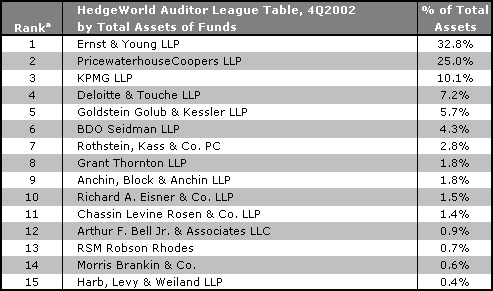
Auditors
|
|
aRank: Based on
a total universe of 2,289 U.S. and international hedge fund
managers and CTAs representing US$317.1 billion in assets under
management reporting a single Auditor relationship to TASS
Research as of 12/31/02. In this ranking, where appropriate the
group or parent company name is used.
|
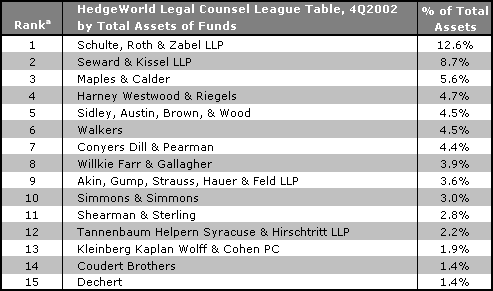
Legal
Counsels
|
|
aRank: Based on
a total universe of 1,638 U.S. and international hedge fund
managers and CTAs representing US$214.1 billion in assets under
management reporting a single Legal Counsel relationship to TASS
Research as of 12/31/02. In this ranking, where appropriate the
group or parent company name is used.
|
![]()
IRS Publication 550:
Loss transactions. For individuals, a loss transaction
is any transaction that results in a deductible loss if the gross
amount of the loss is at least $2 million in a single tax year or $4
million in any combination of tax years. A loss from a foreign
currency transaction under Internal Revenue Code section 988 is a loss
transaction if the gross amount of the loss is at least $50,000 in a
single tax year, whether or not the loss flows through from an S
corporation or partnership.
IRS Publication 334:
Reportable transactions. You must file Form 8886,
Reportable Transaction Disclosure Statement, to report certain
transactions. You may have to pay a penalty if you are required to
file Form 8886 but do not do so. You may also have to pay interest and
penalties on any reportable transaction understatements. Reportable
transactions include (1) transactions the same as or substantially
similar to tax avoidance transactions identified by the IRS, (2)
transactions offered to you under conditions of confidentiality for
which you paid an advisor a minimum fee, (3) transactions for which
you have, or a related party has, contractual protection against
disallowance of the tax benefits, (4) transactions that result in
losses of at least $2 million in any single tax year ($50,000 if from
certain foreign currency transactions) or $4 million in any
combination of tax years, (5) transactions resulting in book-tax
differences of more than $10 million on a gross basis, and (6)
transactions with asset holding periods of 45 days or less and that
result in a tax credit of more than $250,000. For more information,
see the Instructions for Form 8886.
IRS Schedule C instructions:
Reportable Transaction Disclosure Statement: Use Form
8886 to disclose information for each reportable transaction in which
you participated. Form 8886 must be filed for each tax year that your
federal income tax liability is affected by your participation in the
transaction. You may have to pay a penalty if you are required to file
Form 8886 but do not do so. You may also have to pay interest and
penalties on any reportable transaction understatements. The following
are reportable transactions.
- Any transaction resulting in a loss of at least $2 million in
any single tax year or $4 million in any combination of tax years.
(At least $50,000 for a single tax year if the loss arose from a
foreign currency transaction defined in section 988(c)(1), whether
or not the loss flows through from an S corporation or partnership.)
- Any transaction resulting in a book-tax difference of more than
$10 million on a gross basis.
Investor Reporting
You may be required to provide the following information.
1. Reportable transaction disclosure statement.
2. Tax shelter registration number.
Reportable Transaction Disclosure Statement
Use Form 8886 to disclose information for each reportable transaction
in which you participated. Generally, you must attach Form 8886 to
your return for each year that your tax liability is affected by your
participation in the transaction. In addition, for the first year Form
8886 is attached to your return, you must send a copy to:
Internal Revenue Service
LM:PFTG:OTSA
Large & Mid-Size Business Division
1111 Constitution Avenue, NW
Washington, DC 20224
If you fail to file Form 8886 as required or fail to include any
required information on the form, you may have to pay a penalty. See
Penalty for failure to disclose a reportable transaction later under
Penalties.
The following discussion briefly describes reportable transactions.
For more details, see the instructions for Form 8886.
Reportable transaction.
A reportable transaction is any of the following.
• A listed transaction.
• A confidential transaction.
• A transaction with contractual protection.
• Loss transactions.
• Transactions with a significant book-tax difference.
• Transactions with a brief asset holding period. This category
includes transactions that result in your claiming a tax credit
(including a foreign tax credit) of more than $250,000 if the asset
giving rise to the credit was held by you for 45 days or less.
Listed transaction. A listed transaction is a transaction that is the
same as or substantially similar to one of the types of transactions
that the IRS has determined to be a tax-avoidance transaction. These
transactions have been identified in notices, regulations, and other
published guidance issued by the IRS. For a list of existing guidance,
see the instructions for Form 8886.
Confidential transaction. A confidential transaction is one that is
offered to you under conditions of confidentiality and for which you
have paid an advisor a minimum fee. A transaction is offered under
conditions of confidentiality if the advisor who is paid the fee
places a limit on the disclosure of the tax treatment or tax structure
on you and the limit protects the advisor's tax strategies. The
transaction is treated as confidential even if the conditions of
confidentiality are not legally binding on you.
Transaction with contractual protection. Generally, a transaction with
contractual protection is a transaction in which you or a related
party has the right to a full or partial refund of fees if all or part
of the intended tax consequences of the transaction are not sustained,
or a transaction for which the fees are contingent on your realizing
the tax benefits from the transaction.
Loss transactions. For individuals, a
loss transaction is any transaction that results in a deductible loss
if the gross amount of the loss is at least $2 million in a single tax
year or $4 million in any combination of tax years.
A loss from a foreign currency transaction under Internal Revenue Code
section 988 is a loss transaction if the gross amount of the loss is
at least $50,000 in a single tax year, whether or not the loss flows
through from an S corporation or partnership.
Certain losses (such as losses from casualties, thefts, and
condemnations) are excepted from this category and do not have to be
reported on
Form 8886
(see
Form 8886 instructions). For information on other
exceptions, see Revenue Procedure 2003-24 in Internal Revenue
Bulletin 2003-11. This Internal Revenue Bulletin is available at
www.irs.gov/pub/irs-irbs/irb03-11.pdf.
Transactions with a significant book-tax difference. This category
includes transactions that result in book-tax differences of more than
$10 million in any tax year. The book-tax difference is the amount by
which the amount of any income, gain, expense, or loss item from the
transaction for federal income tax purposes differs on a gross basis
from the amount of the item for book purposes for any tax year.
Internal Revenue Code Sec. 988 Tax Shelter
http://www.irs.gov/businesses/article/0,,id=141473,00.html
"Notice 2003-81" Tax Shelter
|
| |
Effective Date: July 26, 2005
Coordinated Issue Paper, All
Industries, "Notice 2003-81" Tax Shelter, UIL 9300.31-00
INTRODUCTION
On December 4, 2003, the Service issued
Notice 2003-81, 2003-2 C.B. 1223,
announcing that it will challenge transactions involving the
assignment of offsetting
foreign currency options to a charity in order to claim
substantial artificial net losses and identifying these
transactions as listed transactions for purposes of I.R.C. §§6011, 6111, and 6112. The transaction is designed to create an
overall net loss (either ordinary or capital) when a taxpayer
transfers two foreign currency contracts to a charity where
only one such contract is subject to the mark-to-market rules
contained in I.R.C. §1256.
ISSUES
-
Whether the tax law permits premium income
received on a taxpayer's written "minor" foreign currency
option contracts to go untaxed where the taxpayer retains
the premium but transfers the obligation associated with
the written option to a charity.
-
Whether a taxpayer participating in this
shelter strategy obtained a timing benefit by being able
to recognize a loss on a purchased foreign currency option
in advance of gain recognition on the premium received for
writing a foreign currency option.
-
Whether a taxpayer's purported loss is a
bona fide loss allowable under I.R.C. §165.
-
Whether the at-risk provisions of I.R.C. §465 limit the taxpayer's claimed loss.
-
Whether the transaction as a whole lacks
economic substance and business purpose apart from tax
savings.
-
Whether the provisions of
I.R.C. §988 limit a taxpayer's claimed foreign currency
losses.
-
Whether the Service should assert the
appropriate I.R.C. §6662 accuracy-related penalty against
a taxpayer who entered into the transaction.
-
Whether the Service should examine the role
of the charity in this transaction.
SUMMARY OF CONCLUSIONS
-
A taxpayer remains obligated to take into
income the premium received for writing a "minor" foreign
currency option contract even if it transfers the
obligation associated with that written option to a
charity.
-
A taxpayer did not obtain a timing benefit
because I.R.C. §1092 does not permit a taxpayer to
recognize loss in advance of gain on offsetting foreign
currency contracts.
-
The taxpayer's loss is not a bona fide loss
allowable under I.R.C. §165.
-
The taxpayer's loss is limited by the I.R.C.
§465 at-risk provisions.
-
The taxpayer's loss is disallowed because
the transaction as a whole lacks economic substance and
business purpose apart from tax savings.
-
The taxpayer is not
entitled to an ordinary loss under I.R.C. §988.
-
The 20-percent accuracy-related penalty
under I.R.C. §6662 should be asserted against a taxpayer
entering into this transaction unless the taxpayer is able
to establish reasonable cause and good faith under I.R.C.
§6664(c)(1) and the applicable regulations.
-
The agent examining the taxable entity
should forward all information gathered about the
involvement of the charity to the Exempt Organizations
Division of TEGE through the process established by the
Notice 2003-81 Issue Management Team.
FACTS
A. Background
Taxpayers deployed Notice 2003-81
transactions in order to offset substantial taxable
income (either capital or ordinary) . Taxpayers initiated the
transactions by entering into an investment management
agreement and opening a trading account managed by the
promoter, who is also a registered investment advisor.
Generally, the initial capital
investment is determined by the anticipated loss needed. The
required investment
amount is equal to either (1) 15% of the desired ordinary loss
or (2) 10% of the desired capital loss. The taxpayer agrees to
leave the funds in the account for a five-year period,
although funds can be withdrawn at any time subject to
significant monetary penalties. A small portion, approximately
1.75%, of the initial capital investment is used to establish
a foreign currency trading account that is used to purchase
foreign currency option contracts. The remaining balance is
invested in a hedge fund of funds that in turn invests in a
variety of investment vehicles including other hedge funds,
stock funds, commodity funds and currency funds.
B. Foreign Currency "Investment"
Strategy
The foreign currency "investment" strategy
involves the purchase and sale of a series of
foreign currency option contracts denominated in both a
foreign currency in which
positions are traded through regulated futures contracts and a
foreign currency that is
not traded through regulated futures contracts. The values of
the two currencies
underlying the options (i) historically have demonstrated a
very high positive correlation with one another, or (ii)
officially have been linked to one another, such as through
the European Exchange Rate Mechanism ("ERM II").1
In one version, the taxpayer buys two 180-day European-style
digital currency options, pegged to fluctuations in the
exchange rate between the U.S. dollar and the euro. These
positions are in a foreign currency traded through regulated
futures contracts, and thus the taxpayer takes the position
that such positions are I.R.C. §1256(g)(2)(A) foreign
currency contracts. In the promotional materials, these
contracts are referred to as the "major options." At the same
time, the taxpayer sells two 180-day European-style digital
currency options, pegged to fluctuations in the exchange rate
between the U.S. dollar and a stated European currency. The
European currency is one in which positions are not traded on
a qualified board or exchange and are not I.R.C. §1256(g)(2)(A) foreign currency contracts. In the promotional
materials, these contracts are referred to as the "minor
options." The counterparty is the same for all four currency
contracts. Therefore, the initial cash outlay to enter into
the foreign currency positions is limited to the net premium
among the offsetting contracts.
In a more complex variation of the
transaction, the taxpayer enters into a series of 180-day
European-style digital options on the same day. Usually, the
taxpayer buys two put options and sells two call options
pegged to fluctuations in the exchange rate between the U.S.
dollar and the euro. This group of options comprises the
"major options." The taxpayer also buys two call options and
sells two put options, pegged to fluctuations in the exchange
rate between the U.S. dollar and a stated European currency.
This group of options comprises the "minor options ." Again,
the counterparty is the same for all eight currency contracts
and the initial cash outlay is relatively small in reference
to the stated notional amounts of the contracts. In some
deals, the taxpayer will enter into a second series of 180-day
European-style options on the following day.
The values of the respective currencies
underlying the foreign currency transactions
historically have demonstrated a very high positive
correlation with one another.
Therefore, the major options will move inversely to the minor
options such that any gain in a major foreign currency
position will be largely offset by a corresponding, though not
always identical, loss in a minor foreign currency position.
The bank, which serves as counterparty for these deals,
generally makes representations to the taxpayer and trader
concerning the statistical probabilities of the potential rate
of return from the option positions indicating a profit is
possible but unlikely. In fact, according to the
analysis provided by the bank, there is usually a better than
50% chance that the
taxpayer will lose its entire investment.
C. Assignment of Major and Minor
Contract to Charity
Prior to the exercise date, that taxpayer
assigns two of its open foreign currency
contracts to a charity. The first contract is a major currency
option contract that is in a
loss position at the time of assignment. The taxpayer also
assigns the obligation that is
associated with a minor currency option contract that is in a
gain position at the time of
assignment of the obligation. The taxpayer takes the position
that (1) the assignment of
the major contract (i.e., I.R.C. §1256 contract) is treated
as a termination of the contract requiring recognition of the
inherent gain or loss in such contract; and (2) the
assignment of the minor contract obligation does not trigger
the recognition of income
because that contract is not covered by the mark-to-market
provisions contained in
I.R.C. §1256.
D. Reporting
of Transaction for Federal Income Tax Purposes
In some cases, the
taxpayer will report the listed transaction on Form 4797,
Part II,
Ordinary Gains and Losses as an I.R.C §988 foreign currency
transaction. The loss
claimed is a direct result from the disparate reporting of the
donated major and minor
contracts. The major contract in a loss position and the
remaining option contracts that are not assigned to the
charity are accounted for on Form 4797. The remaining option
contract positions when closed effectively offset one another.
The reporting exclusion of the gain from the donated minor
contract, which closely mirrors the loss reported from the
donated major contract, creates the artificial loss claimed by
the taxpayer. In other cases, the
taxpayer will report the listed transaction on Schedule D,
Capital Gains & Losses. In these instances,
the taxpayer makes an election pursuant
to I. R.C. §988(a)(1)(B) and Treas. Reg. §1.988-3(b)(4) to
treat its foreign currency contracts as capital assets in
order to claim a capital loss. The taxpayer is required to
attach a verification statement to its filed return for a
valid capital treatment election.
DISCUSSION
1. A taxpayer remains obligated
to take into income the premium that it received when it
writes a "minor" foreign currency option contract and later
transfers the obligation associated with that written option
to a charity.
Gain and loss on options is accounted for on
an open transaction basis. As explained
in Notice 2003-81, the justification for open transaction
treatment is that the gain or loss on an option cannot be
finally accounted for until such time as the option is
terminated. Thus, premium income is not recognized until an
option is sold or terminated. Rev. Rul. 58-234, 1958-1 C.B.
279, Accord Rev. Rul. 78-182, 1978-1 C.B.
265; Koch v.Commissioner, 67 T.C. 71 (1976),
acq. 1980-2 C.B. 1. Rev. Rul. 58-234 explains
that this is the treatment for the option writer because the
option writer assumes a burdensome and continuing obligation,
and the transaction therefore stays open without any
ascertainable income or gain until the writer's obligation is
finally terminated. When the option writer's obligation
terminates, the transaction closes, and the option writer must
recognize any income or gain attributable to the prior receipt
of the option premium.
Though each taxpayer's transaction should be
evaluated independently, the assignment
documents reviewed to date have been three-party arrangements
(involving the option
writer, holder and charity) that seem to give rise to a
novation of the option contracts.
Where there is a novation, the option writer's obligation
under the minor option contract terminates on the charity's
assumption of the written option obligation. However, in other
cases where a novation does not occur, the writer of the minor
foreign currency option writer may well have a continuing
obligation because the writer may be called upon to perform if
the charity fails to perform or to reimburse the charity for
any losses or expenses it may incur if called upon to perform.
If an assumption of the liability by the
charity causes the option writer's obligation under the option
contract to terminate, then the option writer must recognize
gain upon
assignment, when the option obligation is assumed. Notice
2003-81. If the assumption
does not terminate the option writer's obligation under the
option contract, the option
writer must recognize the premium when the option writer's
obligation under the option
contract terminates (other than through an exercise of the
option against, and
performance by, the option writer). Notice 2003-81. It is
generally understood that
charities that received these options may have terminated them
either
contemporaneous with or shortly after the assignments.
Even if a novation did not occur to cause
premium income to be recognized, there is still no support for
the apparent contention that responsibility for recognizing
premium
income shifts to the charity as a result of the assignment of
the obligation on the written
option. At least some of the tax promotional materials
associated with this shelter
transaction suggest that the gain or premium income received
by the taxpayer on the
written option must be recognized by the charity (but goes
untaxed because of its taxexempt status). However, there is no
support for this "too good to be true" result.
Rather, the taxpayers and their advisors seem to simply assume
that a taxpayer can
receive premium income, pass off the obligation associated
with having received that
premium and not be taxed on the premium. No discussion was
found in the materials ,
including an undated draft shelter memorandum ("Shelter
Memorandum"), that explains why the premium received by the
taxpayer is not a taxable accession to wealth of the taxpayer.
Nor is there any explanation as to how a charity could be
taxed on this premium that the charity does not receive.
There is some hint in the promotional
materials that the promoters may have been
seeking to pass off the transfer of the obligation on the
written minor option as a "donation." Generally, taxpayers do not recognize gain upon
transfer of appreciated
property to a qualified charity. See Rev. Rul.
55-138, 1955-1 C.B. 223, modified on
other grounds by Rev. Rul. 68-69, 1968-1 C.B. 80. In these
challenged transactions,
however, property rights were not transferred – only the
obligation associated with the
out-of-the money (losing) purchased option was transferred.
The assumption of an
obligation is not a donation of property to which I.R.C. §170
applies. Rather it is a
disposition event governed by I.R.C. §1001. Crane v.
Commissioner, 331 U.S. 1
(1947). If the assumption of the obligation by the charity
also involves the donation of
associated property, I.R.C. §1001(b) applies and the
transaction is treated as a bargain sale.2
Treas. Reg. §1.1011-2(a)(3); Ebben v. Commissioner,
783 F.2d 906 (9th Cir. 1986). Thus, to the extent there was a
transfer of property along with an associated obligation, the
taxpayers were, in general, properly advised in this scheme
that their charitable deduction for the donated purchased
option rights would be reduced by the amount of liability
relief provided by the charity that assumed the obligation on
the written minor option.
In short, contrary to the advice apparently
received by the taxpayers, there is no factual or legal basis
for the contention that taxpayers in these shelters shifted
the responsibility for recognizing the premium income or gain
on the written minor option position to a charity. Rather, the
taxpayers only transferred an obligation and must be taxed on
the premium that they retain.3
2. A taxpayer did not obtain a
timing benefit because section 1092 does not permit a
taxpayer to recognize loss in advance of gain on the
offsetting foreign currency contracts.
For several reasons, this foreign currency
shelter transaction did not provide a timing
benefit to participating taxpayers.
As explained in issue 1, the open
transaction doctrine deferred a taxpayer's recognition of
premium income only until it became possible to finally
account for the option transaction. As also indicated, a
taxpayer will be required to pick up premium income on the
minor option at the same time as loss is allowed on the major
option under I.R.C. §1256(c) if there was a novation of the
minor option. However, even if a novation did not occur, a
taxpayer was still required to recognize income when that
taxpayer's secondary obligation under the written minor option
contract terminated. That may have occurred in the same tax
year as the assignment because the options were short term and
are understood to have been closed out by the charities either
contemporaneous with or shortly after assignment.
However, even if a charity kept open the
written option obligation beyond the year of
assignment, a taxpayer still would not have obtained an
overall timing advantage. As
indicated in Notice 2003-81, the purchased major foreign
currency option and the
written minor foreign currency option are substantially
offsetting positions.
Consequently, such positions were parts of a straddle subject
to I.R.C. §1092. Thus,
under I.R.C. §1092, any mark-to-market loss on the
contributed major foreign currency option would have been
appropriately deferred to the extent of the taxpayer's
unrecognized gain on the written minor foreign currency
option.
3. The taxpayer's loss is not a
bona fide loss allowable under I.R.C. §165.
I.R.C. §165(a)
provides that there shall be allowed as a deduction any loss
sustained
during the taxable year and not compensated for by insurance
or otherwise. Treas.
Reg. §1.165-1(b) provides that to be allowable as a deduction
under I.R.C. §165(a), a loss must be evidenced by closed and
completed transactions, fixed by identifiable events, and,
except as otherwise provided in I.R.C. §165(h) and Treas.
Reg. §1.165-11 (relating to disaster losses), actually
sustained during the taxable year. Under I.R.C. §165(b), the
amount of the loss from the sale or other disposition of
property is the adjusted basis provided in I.R.C. §1011.
Treas. Reg. §1.165-1(b) further states that only a bona fide
loss is allowable and that substance and not mere form shall
govern in determining a deductible loss. See also ACM
Partnership v. Commissioner, 157 F.3d 231, 252 (3d
Cir. 1998), cert. denied, 526 U.S. 1017
(1999) ["Tax losses . . . which do not correspond to any
actual economic losses, do not constitute the type of ‘bona
fide' losses that are deductible under the Internal Revenue
Code and regulations"]. Section 165(c) provides that, in the
case of an individual, the deduction under §165(a) is limited
to losses incurred in a trade or business, losses incurred in
a transaction entered into for profit, and certain casualty or
theft losses.
In this case, the taxpayer has suffered no
real economic loss because the acquisition
and disposition of the offsetting option contracts constitute
an economically
inconsequential investment, with the taxpayer effectively in
the same economic position
as prior to the purported investment strategy less fees paid
to the promoter. See ACM Partnership v. Commissioner,
157 F.3d at 251-252. Accordingly, the loss is not allowable
under I.R.C. §165.
I.R.C. §165(c) also
disallows the loss for an individual taxpayer. The "loss" in
this
transaction is not incurred in a trade or business or from a
casualty or theft, within the
meaning of I.R.C. §165(c)(1) and (3). Therefore, a loss in
this transaction is only
allowable for an individual if it is incurred in a transaction
undertaken for profit. I.R.C. §165(c)(2); Fox v. Commissioner, 82 T.C.
1001 (1984); Smith v. Commissioner, 78 T.C.
350 (1982). For the loss to be allowable, a profit motive must
be the taxpayer's primary motive for engaging in the
transaction. Fox v. Commissioner, 82 T.C. at
1020-21 [citing Helvering v. National Grocery Co.,
304 U.S. 282, 289 n.5 (1938)].
The taxpayer's potential profit from this
transaction, apart from tax savings, is
statistically improbable. Moreover, any profit generated would
likely be derived from the capital that was invested in the
hedge fund of funds rather than the small amount of
capital used to acquire the major and minor contracts. In
fact, the tax materials distinguish the two investment
components by opining that the "possible profits" from
the tax-driven currency option trading and the "expected
profits" from investing in the
hedge funds create sufficient "economic substance". Therefore,
it is unlikely that a
taxpayer can demonstrate a reasonable expectation to earn more
than minimal profit
solely from the foreign currency investment strategy described
above, apart from tax
savings. See Knetsch v. United States, 348
F.2d 932, 938 (Ct. Cl. 1965) [The statutory definition of
profit under I.R.C. §165(c)(2) "cannot embrace profit seeking
activity in which the only economic gain derived therefrom
results from a tax reduction."].
Therefore, the loss is disallowed under I.R.C. §165(c)(2).
4. The taxpayer's loss is limited
by the I.R.C. §465 at-risk provisions.
I.R.C. §465 generally
limits deductions for losses in certain activities to the
amount for
which the taxpayer is at-risk. In the case of an individual
taxpayer, I.R.C. §465 limits
the taxpayer's losses to the amount for which the taxpayer is
at risk in the activity.
I.R.C. §465(a)(1). I.R.C. §465 applies to all activities
engaged in by the taxpayer in
carrying on a trade or business or for the production of
income. I.R.C. §465(c)(3)(A). Under those sections, losses
incurred in an activity engaged in by a taxpayer carrying on a
trade or business or for the production of income is defined
broadly to include "excess of the allowable deductions
allocable to the activity over the income received or accrued
by the taxpayer during the taxable year from the activity."
Lansburgh v. Commissioner, 92 T.C. 448,
454-55 (1989). This interpretation is supported by the
legislative history of I.R.C. §465 that provides the at risk
limitation applies to losses "regardless of the kind of
deductible expenses which contributed to the loss." S. Rept.
94-938, at 48 (1976), 1976-3 C.B. (Vol.3) 86. In this case,
I.R.C. §465 applies to the loss stemming from taxpayer's
purchase of the foreign currency option contracts.
The amount at-risk includes the amount of
money and the adjusted basis of any
property contributed by the taxpayer to the activity, and any
amounts borrowed with
respect to the activity to the extent that the taxpayer is
personally liable to repay the
amount, and to the extent of the fair market value of the
taxpayer's interest in property, not used in the activity,
pledged as security for the borrowed amount. I.R.C. §465(b)(1) and (2). Amounts protected against loss by nonrecourse financing, guarantees, stop loss agreements, or
other similar arrangements, however, are not at-risk. I.R.C. §465(b)(4). The Senate report promulgated in connection with I.R.C.
§465 states in pertinent part that "a taxpayer's
capital is not ‘at risk' in the business, even as to the
equity capital which he has contributed to the extent he is
protected against economic loss of all or part of such capital
by reason of an agreement or arrangement for compensation or
reimbursement to him of any loss which he may suffer." S. Rept.
No. 94-938, Pt. I at 49, 94th Cong., 2d Sess. (1976).
The at-risk rules in I.R.C. §465 are most
commonly applied to cases involving
nonrecourse liabilities; however, neither the statutory
language nor the legislative
history interprets the at-risk rules that narrowly. The
legislative history notes that the
overall purpose of the at-risk rules is to "prevent a
situation where the taxpayer may
deduct a loss in excess of his econo mic investment in certain
types of activities." S.
Rept. No. 938, Pt. I at 48, 94th Cong., 2d Sess. (1976). The
legislative history also
provides that in evaluating the amount at-risk, it should be
assumed that a loss-protection guarantee, repurchase agreement
or other loss limiting mechanism will
be fully paid to the taxpayer. S. Rep. No. 938, 94th Cong., 2d
Sess. 50 n.6 (1976), C.B. 1976-3 at 88. Although the foregoing
assumption regarding loss-limiting arrangements does not
explicitly claim to interpret I.R.C. §465(b)(4), more than
one circuit has found such an interpretation to be reasonable.
See e.g., Moser v. Commissioner, 914 F.2d
1040, 1048 (8th Cir. 1990); American Principals
Leasing Corp. v. Commissioner, 904 F.2d 477, 482 (9th
Cir. 1990) [assuming in both cases that the reference to
loss-limiting arrangements in I.R.C. §465 legislative history
refers to I.R.C.§465(b)(4)]. I.R.C. §465(b)(4) limits losses
to amounts at risk where a transaction is structured, by
whatever method, to remove any realistic possibility that the
taxpayer will suffer an economic loss. A theoretical
possibility of economic loss is insufficient to avoid the
suspension of losses. See Levien v.Commissioner,
103 T.C. 120, 125 (1994).
The case law, however, is not in complete
accord on this issue. In Emershaw v.
Commissioner, 949 F.2d 841, 845 (6th Cir. 1991), the
court adopted a worst-case
scenario approach and determined that the issue of whether a
taxpayer is "at risk" for
purposes of I.R.C. §465(b)(4) "must be resolved on the basis
of who realistically will be the payor of last resort if the
transaction goes sour and the secured property associated with
the transaction is not adequate to pay off the debt." quoting
Levy v. Commissioner, 91 T.C. 838, 869
(1988). In contrast, the Second, Eighth, Ninth, and Eleventh
Circuits look to the underlying economic substance of the
arrangements under I.R.C. §465(b)(4). Waters v.
Commissioner, 978 F.2d 1310, 1316 (2d Cir. 1992)
(citing American Principals Leasing Corp v. United
States, 904 F.2d 477, 483 (9th Cir. 1990);
Young v. Commissioner, 926 F.2d 1083, 1089 (11th Cir.
1991); Moser v. Commissioner, 914 F.2d at
1048-49. The view, as adopted by these circuits, is that, in
determining who has the ultimate liability for an obligation,
the economic substance and the commercial realities of the
transaction control. See Waters v. Commissioner,
978 F.2d at 1316; Levien v. Commissioner, 103
T.C. 120; Thornock v. Commissioner, 94 T.C.
439, 448 (1990); Bussing v. Commissioner, 89
T.C. 1050, 1057 (1987). To determine whether a taxpayer is
protected from ultimate liability, a transaction should be
examined to see if it "is structured - by whatever method - to
remove any realistic possibility that the taxpayer will suffer
an economic loss if the transaction turns out to be
unprofitable."
American Principals Leasing Corp. v. United States,
904 F.2d at 483; See Young v. Commissioner,
926 F.2d at 1088; Thornock v. Commissioner,
94 T.C. at 448-49; Owens v. United States,
818 F.Supp. 1089, 1097 (E.D. Tenn. 1993); Bussing v.
Commissioner, 89 T.C. at 1057-58. "[A] binding
contract is not necessary for [I.R.C. §465(b)(4)] to apply."
American Principals Leasing Corp. v United States,
904 F.2d at 482-83. In addition, "the substance and commercial
realities of the financing arrangements presented . . . by
each transaction" should be taken into account under I.R.C. §465(b)(4). Thornock v. Commissioner, 94 T.C.
at 449. To avoid the application of I.R.C. §465(b)(4), there
must be more than "a theoretical possibility that the taxpayer
will suffer economic loss." American Principals
Leasing Corp. v United States, 904 F.2d at 483.
In the typical "Notice 2003-81" deal, the
counterparty to all the foreign currency
contracts is the same. Due to the fact that the currency
movements between the euro
and European currency used in the minor contracts closely
parallel each other, the
taxpayer's cash investment is relatively small. The
transaction is carefully structured so
that any gain in one option position is largely offset by a
loss in another contract.
Therefore, the taxpayer's true at-risk amount equals the net
out of pocket premium paid to acquire the aggregate offsetting
foreign currency positions.
5. The taxpayer's loss
is disallowed because the transaction as a whole lacks
economic substance and business purpose apart from tax
savings.
In addition to the statutory provisions
discussed herein, the taxpayer's purported loss
may be disallowed under the economic substance doctrine. This
approach would deny
the tax benefits arising because the transaction does not
result in a meaningful change
to the taxpayer's economic position other than the
manufactured loss that results in the
purported reduction in tax. See Knestch v. United
States, 364 U.S. 361 (1960). The Tax Court has stated
that tax law "requires that the intended transactions have
economic substance separate and distinct from economic benefit
achieved solely by tax reduction." ACM Partnership v.
Commissioner, T.C. Memo. 1997-115, aff'd in
part and rev'd in part, 157 F.3d 231 (3rd Cir. 1998).
Accordingly, this doctrine is applicable to the typical Notice
2003-81 transaction where the purported tax benefits are
unintended by Congress and accomplished by a prearranged deal
that serves no economic purpose apart from tax savings.
In determining whether a transaction is to
be respected for tax purposes, both the
objective economic substance of the transaction and the
subjective business motivation
are considered. ACM Partnership v. Commissioner,
157 F.3d 231, 247 (3d Cir. 1998); Horn v. Commissioner,
968 F.2d 1229, 1237 (D.C. Cir. 1992); Casebeer v.
Commissioner, 909 F.2d 1360, 1363 (9th Cir. 1990).
Some courts apply a conjunctive analysis that requires a
taxpayer to establish the presence of both economic substance
(i.e., objective test) and business purpose (i.e., subjective
test to determine whether the taxpayer intended the
transaction to serve some useful non-tax purpose). See
Pasternak v. Commissioner, 990 F.2d 893, 898 (6th
Cir. 1993). Other courts apply a less stringent test that
either a subjective business purpose or actual economic
substance is sufficient. Rice's Toyota World v.
Commissioner, 752 F.2d 89, 91-92 (4th Cir. 1985). An
alternative analysis views economic substance and business
purpose as "simply more precise factors to consider" in
determining whether a transaction has any practical economic
effects other than the tax benefits created. ACM
Partnership v. Commissioner, 157 F.3d at 247.
See also Casebeer v. Commissioner, 909 F.2d at 1363;
Sacks v. Commissioner, 69 F.3d 982, 985 (9th
Cir. 1995); James v. Commissioner, 899 F.2d
905, 908 (10th Cir. 1995). In addition, several courts have
applied the economic substance doctrine where a taxpayer was
exposed to limited risk and the transaction had a theoretical
potential for profit but the profit potential was nominal and
insignificant when compared to the tax benefit derived.
Gregory v. Helvering, 293 U.S. 465 (1935)
[Transaction that is entered into for the primary purposes of
creating a loss is subject to special scrutiny to determine
whether such loss was bona fide]; Knetsch v. United
States, 364 U.S. 361 (1960) [Leveraged acquisition of
Treasury bills and accompanying prepaid interest deduction
lacked economic substance]; Goldstein v. Commissioner,
364 F.2d 734 739-40 (2d Cir. 1966)[Deduction disallowed even
though taxpayer has a possibility of small gain or loss from
ownership of Treasury bills]; Sheldon v. Commissioner,
94 T.C. 738, 768 (1990)[Loss disallowed
from prearranged substantially offsetting transaction where
profit potential "infinitesimally nominal and vastly
insignificant" in comparison to loss claimed]; Rice's
Toyota World v. Commissioner, 752 F.2d at 94;
[Economic substance inquiry requires an objective
determination of whether reasonable possibility of profit
existed apart from tax benefits]. See also Compaq
Computer Corp v. Commissioner, 277 F.3d at 781;
IES Industries v. United States, 253 F.3d at
354 [Applying same objective economic substance test discussed
in Rice's Toyota World].
The doctrine of economic substance should be
raised in cases where the facts show
that the transaction at issue was primarily designed to
generate the tax losses, with little
if any possibility for profit, and that such was the
expectation of all the parties to the
transaction. The wide variety of facts required to support its
application should be
developed at examination. The administrative record should
include documents
obtained from the taxpayer, the promoter and other third
parties; interviews with the
same; and expert analysis of financial data and industry
practices. Summonses should
be promptly issued whenever necessary to obtain the requisite
transactional
documents.
In addition to evidence that shows a lack of
pre-tax profit potential, facts should be
developed demonstrating that the taxpayer and the promoter
primarily planned the
transaction for tax purposes. Such evidence should include the
following: (1)
documents or other evidence that the foreign currency option
contracts were sold as tax shelters with limited consideration
of the underlying economics of the transaction; and (2)
evidence that a prudent investor would not have invested in
the strategy but for the tax savings. A primary source of such
evidence is correspondence between the
promoter and the taxpayer, including, but not limited to,
offering memos, letters
identifying tax goals, e -mails and in-house communications at
the offices of the
promoter and any other third party involved in the strategy.
Written correspondence is
the best evidence, but evidence of oral communications
regarding tax goals is also
useful. Indirect sources of the same include correlations
between tax losses generated
and tax losses requested, and between the taxpayer's income
and the tax losses
generated, particularly if it can be shown that the income to
be sheltered was
attributable to an unusual windfall, like the liquidation of
stock options, or sale of a
business. Demonstrations of similarities of the nature and extent of tax losses acquired
by other clients of the promoter in this shelter can be very
important as well.
In the typical case, the transaction fails
both prongs of the economic substance
analysis. The following facts underscore a lack of a
legitimate potential or realistic
possibility for a pre-tax profit (i.e objective prong): First,
the taxpayer's profit potential
from the aggregate foreign currency options is severely
limited by the offsetting nature
of the respective contracts. Although not a traditional
straddle, the option contracts
create substantially offsetting positions whereby any gain in
one contract is offset in
another contract. Second, the profit, if any, would be derived
from the contractual
provision that required a payment equal to twice the premium
amount to the holder if the strike price was at or above a
stated amount on the exercise date. Third, the net
premium paid to enter the option contracts is a mere 1.75% of
the actual loss claimed.
Fourth, any potential profit realized would be further reduced
by significant up -front
transaction costs. The fees paid to the promoter were 5% for a
capital loss or 6% for
any ordinary loss desired. Fifth, the only true profit
potential comes from the additional
hedge fund investment that represents a distinct investment
separate from the foreign
currency scheme. This "real" investment, which was a
prerequisite to obtaining the
desired loss, provides the trappings of legitimacy and creates
the illusion of profit when
aggregated with the tax shelter investment. These facts
persuasively demonstrate the
lack of any realistic potential for pre-tax profit from the
foreign currency strategy.
The transaction also fails the subjective
economic substance prong. Typically, the
taxpayer has significant taxable income (either capital gain
income or ordinary income)
unrelated to the transaction. Through participation in this
transaction, the taxpayer is
able to choose the character and amount of the loss needed to
offset the unrelated
income. The close connection between the taxable income being
sheltered and the
claimed loss suggests that the taxpayer did not enter into
this transaction for a business
purpose. As the Tenth Circuit has recognized, "correlation of
losses to tax needs
coupled with a general indifference to, or absence of,
economic profits may reflect a
lack of economic substance." Keeler v. Commissioner,
243 F.3d 1212, 1218 (10th Cir. 2001), citing Freytag
v. Commissioner, 89 T.C. 849, 877-878 (1987). Here,
the taxpayer does not have a substantial non-tax purpose for
entering into the structured transaction other than the
creation of an artificial tax loss.
If the revenue agent, after consultation
with Financial Products specialist and/or
economist, determines that it is appropriate to assert
economic substance with respect
to a specific transaction, consideration must be given to
possible appellate venue. As
discussed herein, various circuits apply different standards
in determining whether a
transaction lacks economic substance. Prior to asserting
economic substance, the
examiner should consult with local Counsel to determine the
appropriate standard in
their jurisdiction.
In cases where a taxpayer who invested in
the transaction is unable to establish that (1) the
transaction changes in a meaningful way (apart from Federal
income tax
consequences) the taxpayer's economic position and (2) that
the taxpayer has a
substantial non-tax purposes for entering into such
transaction and the transaction is a
reasonable means of accomplishing such purpose the tax
benefits, fees or expenses,
related thereto, may be disallowed.
6. The
taxpayer is not entitled to an ordinary loss under I.R.C. §988.
I.R.C. §§985-989,
which were enacted as part of the Tax Reform Act of 1986, set
forth a comprehensive set of rules for the treatment of
foreign currency transactions. In
general, I.R.C. §988(a)(1)(A) provides that foreign currency
gain or loss attributable to an I.R.C. §988 transaction is
computed separately and treated as ordinary income or loss.
The I.R.C. §988 foreign currency transaction rules generally
apply to forward
contracts, futures contracts, options contracts and similar
financial instruments.
The legislative history of I.R.C. §§985-989
suggests a consistent concern about tax
motivated transactions. The Senate Finance Committee Report
accompanying the Tax
Reform Act of 1986 stated that one of the two reasons I.R.C.
§§985-989 were enacted was prior law provided opportunities
for tax motivated transactions. S. Rep. No. 313., 99th Cong.,
2d Sess. 450 (1986). Accordingly, in enacting I.R.C. §§985-989, Congress granted broad authority for the Service to
promulgate regulations "as may be necessary or appropriate to
carry out the purposes of [I.R.C. §§985-989]. . . ." I.R.C.
§989(c). The legislative history to the TAMRA, in discussing
the law prior to the enactment of TAMRA, stated that "[t]he
Secretary has general authority to provide the regulations
necessary or appropriate to carry out the purposes of new
subpart J. For example, the Secretary may prescribe
regulations appropriately recharacterizing transactions to
harmonize the general realization and recognition provisions
of the Code with the policies of §988." H.R. Rep. No. 795,
100th Cong., 2d Sess. 296 (1988); S. Rep. No. 445, 100th
Cong., 2d Sess. 311 (1988) (containing identical language).
In response to Congressional concern about
tax motivated transactions, the Service,
under the authority of I.R.C. §989(c), promulgated Treas.
Reg. §1.988-2(f) and Treas. Reg. §1.988-1(a)(11). Treas.
Reg. §1.988-2(f) states that if the substance of a
transaction differs from its form, the Commissioner may
recharacterize the timing,
source, and character of gains or losses with respect to the
transaction in accordance
with the substance of the transaction. Treas. Reg. §1.988-1(a)(11) states, in relevant
part, that the Commissioner may exclude a transaction or
series of transactions which in form is an I.R.C. §988
transaction from the provisions of I.R.C. §988 if the
substance of the transaction, or series of transactions
indicates that it is not properly considered an I.R.C. §988
transaction.
In this case, the transaction at issue may
be recharacterized in accordance with its
substance so that the taxpayer is required to take i nto
account gain as well as the
economically corresponding loss under Treas. Reg. §1.988-2(f). For purposes of I.R.C.
§988, the Service may
adjust the timing of the transaction at issue consistently
with its substance and require the taxpayer to recognize gain
upon the transfer of the minor contract to the charity on the
date of such transfer. The taxpayer's ordinary loss as
reported on its return does not reflect the substance of the
transaction because the
Investor is not economically exposed to fluctuations in the
values of the foreign currency positions. The claimed loss is
not the result of exposure to exchange rate fluctuations, but
rather of differences in timing of recognition of economically
offsetting gain and loss positions in an engineered
transaction. Accordingly, under Treas. Reg. §1.988-2(f), the
taxpayer is required to take both gain and loss into account
consistently.
Alternatively, the loss may be excluded from
I.R.C. §988 under Treas. Reg. §1.988-1(a)(11) because the reported loss is due to the different
reporting methods of the major and minor contracts and does
not reflect changes in foreign currency exchange rates.
Excluding the transaction from the provisions of I.R.C. §988
under this alternative approach, however, would result in
capital loss treatment. Barnes Group v. United States,
697 F. Supp 591 (D. Conn. 1988).
7. The 20 percent accuracy-related
penalty under I.R.C. §6662 should be asserted against a
taxpayer entering into this transaction unless the taxpayer
is able to establish reasonable cause and good faith under I.R.C.
§6664(c)(1) and applicable regulations.
I.R.C. §66624
imposes an accuracy-related penalty in an amount equal to 20
percent of the portion of an underpayment attributable to,
among other things: (1) negligence or disregard of rules or
regulations and (2) any substantial understatement of income
tax. Treas. Reg. §1.6662- 2(c) provides that there is no
stacking of the accuracy-related penalty components. Thus, the
maximum accuracy-related penalty imposed on any portion of an
underpayment is 20 percent (40 percent for gross valuation
misstatements), even if that portion of the underpayment is
attributable to more than
one type of misconduct. See D.H.L. Corp. v.
Commissioner, T.C. Memo. 1998-461, aff'd in
part and rev'd on other grounds, remanded
by 285 F.3d 1210 (9th Cir. 2002).
In order to facilitate the examiner's review
of the relevant facts and circumstances
associated with application of the I.R.C. §6662 penalty, this
paper first provides a
general overview of the law associated with the penalty where
there is (a) negligence or disregard of rules or regulations
and (b) any substantial understatement of income tax. After
the general overview, some more practical suggestions are
offered based on the information that has been reviewed to
date – including the above -referenced shelter promotion
materials and Shelter Memorandum. Much of the focus in that
later
discussion is on substantial understatement.
Negligence or Disregard of Rules or
Regulations
Negligence under I.R.C. §6662 includes any
failure to make a reasonable attempt to
comply with the provisions of the Internal Revenue Code or to
exercise ordinary and
reasonable care in the preparation of a tax return. See I.R.C.
§6662(c) and Treas. Reg. §1.6662-3(b)(1). Negligence also
includes the failure to do what a reasonable and ordinarily
prudent person would do under the same circumstances.
See Marcello v. Commissioner, 380 F.2d 499, 506 (5th
Cir. 1967), aff'g 43 T.C. 168 (1964); Neely v.
Commissioner, 85 T.C. 934, 947 (1985). Treas. Reg. §1.6662-3(b)(1)(ii) provides that negligence is strongly
indicated where a taxpayer fails to make a reasonable attempt
to ascertain the correctness of a deduction, credit or
exclusion on a return that would seem to a reasonable and
prudent person to be "too good to be true" under the
circumstances. A return position that has a reasonable basis
as defined in Treas. Reg. §1.6662-3(b)(3) is not attributable
to negligence. Treas. Reg. §1.6662-3(b)(1).
"Disregard of rules and regulations"
includes any careless, reckless, or intentional
disregard of rules and regulations. A disregard of rules or
regulations is "careless" if the
taxpayer does not exercise reasonable diligence in determining
the correctness of a
position taken on its return that is contrary to the rule or
regulation. A disregard is
"reckless" if the taxpayer makes little or no effort to
determine whether a rule or
regulation exists, under circumstances demonstrating a
substantial deviation from the
standard of conduct observed by a reasonable person.
Additionally, a disregard of the
rules and regulations is "intentional" where the taxpayer has
knowledge of the rule or
regulation that it disregards. Treas. Reg. §1.6662-3(b)(2).
The term "rules and regulations" includes
the provisions of the Internal Revenue Code,
temporary or final treasury regulations, and revenue rulings
or notices (other than
notices of proposed rulemaking) issued by the Internal Revenue
Service and published
in the Internal Revenue Bulletin. Treas. Reg. §1.6662-3(b)(2). Therefore, if the facts
indicate that a taxpayer took a return position contrary to
any published notice or
revenue ruling, the taxpayer may be subject to the
accuracy-related penalty for an
underpayment attributable to disregard of rules and
regulations, if the return position
was taken subsequent to the issuance of the notice or revenue
ruling.
The accuracy-related penalty for disregard
of rules and regulations will not be imposed
on any portion of underpayment due to a position contrary to
rules and regulations if: (1) the position is disclosed on a
properly completed Form 8275 or Form 8275-R (the latter is
used for a position contrary to regulations) and (2) in the
case of a position contrary to a regulation, the position
represents a good faith challenge to the validity of a
regulation.5 Treas. Reg. §1.6662-3(c). This adequate disclosure exception applies only
if the taxpayer has a reasonable basis for the position and
keeps adequate records to substantiate items correctly. Treas.
Reg. §1.6662-3(c)(1). Moreover, a taxpayer who takes a
position contrary to a revenue ruling or a notice has not
disregarded the ruling or notice if the contrary position has
a realistic possibility of being sustained on its merits.
Treas. Reg. §1.6662-3(b)(2).
The taxpayer has the ultimate burden of
overcoming the presumption that the Service's
determination of negligence is correct. Marcello v.
Commissioner, 380 F.2d 499, 507 (5th Cir. 1967). With
respect to examinations commencing after July 22, 1998,
however, the Service must first meet the burden of production
with respect to
negligence. I.R.C. §7491(c); Higbee v. Commissioner,
116 T.C. 438, 446 (2002).
Substantial Understatement
A substantial understatement of income tax
exists for a taxable year if the amount of the understatement
exceeds the greater of 10 percent of the tax required to be
shown on the return or $5,000 ($10,000 for a corporation,
other than an S corporation or a
personal holding company). I.R.C. §6662(d)(1). Specific rules
apply to the calculation of the understatement when any
portion of the understatement arises from an item attributable
to a tax shelter. For purposes of I.R.C. §6662(d)(2)(C), a
tax shelter is a partnership or other entity, an investment
plan or arrangement, or other plan or arrangement where a
significant purpose of such partnership, entity, plan or
arrangement is the avoidance or evasion of federal income tax.
I.R.C. §6662(d)(2)(C)(iii). Because a significant purpose of
the Notice 2003-81 transaction is
tax avoidance, it is a tax shelter pursuant to I.R.C. §6662(d)(2)(C). Different rules,
however, apply depending upon whether the taxpayer is a
corporation or an individual
or entity other than a corporation.
In the case of any item of a taxpayer other
than a corporation, which is attributable to a tax shelter,
understatements are generally reduced by the portion of the
understatement attributable to: (1) the tax treatment of items
for which there was substantial autho rity for such treatment,
and (2) the taxpayer reasonably believed that the tax
treatment of the item was more likely than not the proper
treatment. I.R.C. §6662(d)(2)(C)(i).6
The substantial authority standard is an objective standard
involving an analysis of the law and application of the law to
relevant facts. Treas. Reg. §1.6662-4(d)(1). Here, there was
no substantial authority for the tax treatment of this
transaction. A taxpayer is considered to have reasonably
believed that the tax treatment of an item is more likely than
not the proper tax treatment if (1) the taxpayer analyzes the
pertinent facts and authorities, and based on that analysis
reasonably concludes, in good faith, that there is a greater
than 50% likelihood that the tax treatment of the item will be
upheld if the Service challenges it, or (2) the taxpayer
reasonably relies, in good faith, on the opinion of a
professional tax advisor, which clearly states (based on the
advisor's analysis of the pertinent facts and authorities)
that the advisor concludes there is a greater than 50%
likelihood the tax treatment of the item will be upheld if the
Service challenges it. Treas. Reg. §1.6662-4(g)(4). However,
a taxpayer cannot claim to have reasonably relied in good
faith on the opinion of a professional tax advisor if the
requirements of Treas. Reg. §1.6664-4(c)(1) are not met.
Treas. Reg. §1.6662-4(g)(4)(ii). (As a practical matter, the
requirement that the opinion take into account the particular
motivations and
circumstances of the taxpayer makes reliance on a "canned"
opinion inherently
questionable.) This is discussed further under "Reasonable
Cause Exception" below.
If the item is attributable to a tax shelter
and the taxpayer is a corporation, the
understatement cannot be reduced.7
I.R.C. §6662(d)(2)(C)(ii). Therefore, if a
corporate taxpayer has a substantial understatement that is
attributable to a tax shelter
item, the accuracy related penalty applies to the underpayment
arising from the
understatement unless the reasonable cause and good faith
exception applies.
Reasonable Cause Exception
I.R.C. §6664(c)
provides an exception, applicable to all types of taxpayers,
to the
imposition of any accuracy-related penalty if the taxpayer
shows that there was
reasonable cause and the taxpayer acted in good faith. Special
rules apply to items of
a corporation attributable to a tax shelter resulting in a
substantial understatement.
The determination of whether the taxpayer
acted with reasonable cause and in good
faith is made on a case-by-case basis, taking into account all
relevant facts and
circumstances. See Treas. Reg. §1.6664-4(b)(1) and Treas. Reg.
§1.6664-4(f)(1). All relevant
facts, including the nature of the tax investment, the
complexity of the tax
issues, issues of independence of a tax advisor, the
competence of a tax advisor, the
sophistication of the taxpayer, and the quality of an opinion,
must be developed to
determine whether the taxpayer was reasonable and acted in
good faith.
Generally, the most important factor in
determining whether the taxpayer has
reasonable cause and acted in good faith is the extent of the
taxpayer's effort to assess
the proper tax liability. See Treas. Reg. §1.6664-4(b)(1);
see also Larson v.
Commissioner, T.C. Memo. 2002-295; Estate of
Simplot v. Commissioner, 112 T.C. 130, 183 (1999)
(citing Mandelbaum v. Commissioner, T.C.
Memo. 1995-255), rev'd on other grounds, 249
F.3d 1191 (9th Cir. 2001). For example, reliance on erroneous
information reported on an information return indicates
reasonable cause and good faith, provided that the taxpayer
did not know or have reason to know that the information was
incorrect. Similarly, an isolated computational or
transcription error is not inconsistent with reasonable cause
and good faith. Treas. Reg. §1.6664-4(b)(1).
Circumstances that may suggest reasonable
cause and good faith include an honest
misunderstanding of fact or law that is reasonable in light of
the facts, including the
experience, knowledge, sophistication and education of the
taxpayer. Treas. Reg. §1.6664-4(b)(1). The taxpayer's mental and physical condition,
as well as sophistication with respect to the tax laws, at the
time the return was filed, are relevant in deciding whether
the taxpayer acted with reasonable cause. See Kees v.
Commissioner, T.C. Memo. 1999-41. If the taxpayer is
misguided, unsophisticated in tax law, and acts in good faith,
a penalty is not warranted. See Collins v.
Commissioner, 857 F.2d 1383, 1386 (9th Cir. 1988);
cf. Spears v. Commissioner, T.C. Memo. 1996-341, aff'd, 98-1
USTC ¶ 50,108 (2d Cir. 1997)[Court was unconvinced by the
claim of highly sophisticated, able, and successful investors
that they acted reasonably in failing to inquire about their
investment and simply relying on offering circulars and
accountant, despite warnings in offering materials and
explanations by accountant about limitations of accountant's
investigation].
Reliance upon a tax opinion provided by a
professional tax advisor may serve as a
basis for the reasonable cause and good faith exception to the
accuracy-related
penalty. The reliance, however, must be objectively
reasonable, as discussed more fully below. For example, the
taxpayer must supply the professional with all the necessary
information to assess the tax matter. The advice also must be
based upon all pertinent facts and circumstances and the law
as it relates to those facts and circumstances.
The advice must not be based on unreasonable
factual or legal assumptions (including
assumptions as to future events) and must not unreasonably
rely on the
representations, statements, findings, or agreements of the
taxpayer or any other
person. For example, the advice must not be based upon a
representation or
assumption which the taxpayer knows, or has reason to know, is
unlikely to be true,
such as an inaccurate representation or assumption as to the
taxpayer's purposes for
entering into a transaction or for structuring a transaction
in a particular manner. See Treas. Reg. §1.6664-4(c)(1)(ii).
In Long Term Capital Holdings v.
United States, 330 F. Supp.2d 122 (D. Conn. 2004),
the court concluded that a legal opinion did not provide a
taxpayer with reasonable cause where (1) the taxpayer did not
receive the written opinion prior to filing its tax return,
and the record did not establish the taxpayer's receipt of an
earlier oral opinion upon which it would have been reasonable
to rely; (2) the opinion was based upon unreasonable
assumptions; (3) the opinion did not adequately analyze the
applicable law; and (4) the taxpayer's partners did not
adequately review the opinion to determine whether it would be
reasonable to rely on it. In addition, the court concluded
that the taxpayer's lack of good faith was evidenced by its
decision to attempt to conceal the losses reported from the
transaction by netting them against gains on its return.
Where a tax benefit depends on nontax
factors, the taxpayer has a duty to investigate
the underlying factors rather than simply relying on
statements of another person, such
as a promoter. See Novinger v. Commissioner,
T.C. Memo. 1991-289. Further, if the tax advisor is not versed
in these nontax matters, mere reliance on the tax advisor does
not suffice. See Addington v. United States,
205 F.3d 54, 58 (2d Cir. 2000); Collins v.
Commissioner, 857 F.2d 1383, 1386 (9th Cir. 1988)
Freytag v. Commissioner, 89 T.C. 849, 888
(1987), aff'd,904 F.2d 1011 (5th Cir. 1990).
Although a professional tax advisor's lack of independence is
not alone a basis for
rejecting a taxpayer's claim of reasonable cause and good
faith, the fact that a taxpayer knew or should have known of
the advisor's lack of independence is strong evidence that the
taxpayer may not have relied in good faith upon the advisor's
opinion. See Neonatology Associates, P.A. v.
Commissioner, 115 T.C. 43, 98 (2001), aff'd 299 F.3d
221 (3rd Cir. 2002) ["Reliance may be unreasonable when it is
placed upon insiders, promoters, or their offering materials,
or when the person relied upon has an inherent conflict of
interest that the taxpayer knew or should have known about"];
Goldman v. Commissioner, 39 F.3d 402, 408 (2d
Cir. 1994) aff'g T.C. Memo. 1993-480 ["Appellants cannot
reasonably rely for professional advice on someone they know
to be burdened with an inherent conflict of interest"];
Marine v. Commissioner, 92 T.C. 958, 992-93
(1989), aff'd without published opinion, 921 F.2d 280 (9th
Cir. 1991). Such reliance is especially unreasonable when the
advice would seem to a reasonable person to be "too good to be
true." Pasternak v. Commissioner, 990 F.2d
893, 903 (6th Cir. 1993), aff'g Donahue v.
Commissioner, T.C. Memo. 1991-181; Gale v.
Commissioner, T.C. Memo.
2002-54; Elliot v. Commissioner, 90 T.C. 960,
974 (1988), aff'd without published opinion,
899 F.2d 18 (9th Cir. 1990); Treas. Reg. §1.6662-3(b)(2).
Similarly, the fact that a taxpayer
consulted an independent tax advisor is not, standing
alone, conclusive evidence of reasonable cause and good faith
if additional facts
suggest that the advice is not dependable. Edwards v.
Commissioner, T.C. Memo.
2002-169; Spears v. Commissioner, T.C. Memo.
1996-341, aff'd, 98-1 USTC ¶ 50,108 (2d Cir. 1997). For
example, a taxpayer may not rely on an independent tax adviser
if the taxpayer knew or should have known that the tax adviser
lacked sufficient expertise, the taxpayer did not provide the
advisor with all necessary information, or the information the
advisor was provided was not accurate." Baldwin v.
Commissioner, T.C. Memo. 2002- 162; Spears v.
Commissioner, T.C. Memo. 1996-341, aff'd, 98-1 USTC ¶
50,108 (2d Cir. 1997).
Observations Regarding Application of
Penalty to This Shelter
When it appears that imposing the
accuracy-related penalty is warranted, the examiner
needs to carefully evaluate the application of the penalty for
each taxpayer that is
audited. This review is made somewhat easier by the fact that
taxpayers must satisfy
more stringent standards to avoid application of the penalty
where the substantial
understatement is in connection with a tax shelter
transaction. From a practical
standpoint, it will be critical for the examiner to focus upon
whether the taxpayer based its return position on a more
likely than not legal opinion of a professional tax advisor
that considered all pertinent facts and lines of legal
authority. Based on the review of the limited materials
gathered to date in connection with this shelter transaction,
it may be quite difficult for taxpayers to show that they
satisfied that standard.
As an initial matter, the examiner should
determine whether the taxpayer obtained or
relied upon a signed and dated legal opinion that
unambiguously concludes that the
taxpayer's return positions were more likely than not to be
sustained if challenged. If
the taxpayer has not reasonably relied on such an opinion,
then the accuracy-related
penalty should be asserted.
Moreover, while all facts would still have
to be considered, the accuracy-related penalty should also
apply if the taxpayer simply relied on a "canned" legal
opinion that does not address that taxpayer's particular
circumstances. Almost by definition, such a "canned opinion
could not be reasonably relied upon because it would not
address the taxpayer's particular motivations and other
pertinent circumstances.
Even if the taxpayer could have reasonably
relied on a "canned" legal opinion or one
that is directed to the taxpayer, it will be necessary to
evaluate whether the opinion took into account all pertinent
facts and lines of legal authority. If the draft Shelter
Memorandum is a good barometer of the quality of the opinions,
if any, provided to
taxpayers, the examiner may find that highly pertinent facts
were overlooked or
misstated. For instance, it is plainly troubling that the
draft Shelter Memorandum
reached its conclusions regarding section 1092 by assuming
that the assigned foreign
currency options were not substantially offsetting positions
even though separate
promotional documents clearly tout the positions as being
almost completely offsetting.
Moreover, the legal memorandum virtually ignores all
discussion of the economics and
legal effects of the assignments.
In addition, it will be critical to examine
whether the legal opinion addressed all relevant lines of
legal authority. As a guide, the examiner should determine if
each of the legal issues raised in this CIP were meaningfully
considered. The draft Shelter Memorandum was clearly deficient
in that regard. For instance, the legal memorandum failed to
consider any authority that addresses the tax accounting for
options and failed to consider whether the form of assignment
caused gain or loss to be recognized under
the open transaction doctrine. Though section 988 was
considered, the draft
memorandum also failed to consider the anti-abuse rules of
Treas. Reg. 1.988-2(f).
8. The agent examining the taxable
entity should forward all information
gathered about the involvement of the charity to the Exempt
Organizations Division of TEGE through the process
established by the Notice 2003-81 Issue Management Team.
Through IDRs and otherwise, the agent
examining a taxable entity that entered into one of these
transactions will obtain information about the involvement of
the charity. In all cases, the agent should forward that
information to the Exempt Organizations Division of TEGE
through the process established by the Notice 2003-81 Issue
Management Team. Examiners should refer to the Notice 2003-81
toolkit for the most current EO contact information, including
contact person, address, phone and fax numbers. Information
provided by the examiners to Exempt Organizations will be
helpful in alerting Examination and Determination Agents so
they may identify issues and take appropriate actions.
Exempt Organizations will need to exercise
discretion in determining how to proceed
with the information that it receives because the nature of
the charity's involvement in
these transactions may vary. In some cases, a "charity" may
have been created by the
promoter or someone affiliated with the promoter specifically
to facilitate these
transactions. The custom-made charity may purport to engage in
appropriate charitable activities, but evidence could show
substantial and/or repeated involvement as the accommodation
party in the transaction. Other cases may involve charities
that are well-established in their appropriate charitable
endeavors but that appear as
accommodation parties in these or other abusive tax
transactions. Their involvement
may appear on the books simply as a donation, as a net
donation from offsetting
options or property, or as part of an investment portfolio.
The Service will apply the full array of
enforcement tools to those entities whose focus is on
accommodating abusive tax transactions. Playing that role does
not further a
charitable or other tax-exempt purpose. If this role is
apparent in the application
process for exemption, the Service will not recognize the
entity as exempt. If the
Service discovers this abusive behavior after having already
recognized the entity as
exempt, the Service will move to revoke the entity's
exemption, possibly back to its
inception.
Where the Service learns that an otherwise
compliant charity has become involved in
an abusive transaction as an accommodating party, whether
booked as a donation, fee, investment, or otherwise, the
charity may expect to be contacted by the Service. The charity
may be requested to provide the details of its involvement,
information about the transaction and other parties, etc.
Depending on the circumstances, this contact may be made by
the Exempt Organizations Division as a compliance check with
respect to the Form 990 or other return, or as part of an
inquiry into the charity's own taxation and exemption status
or other associated tax issues. In the alternative, it may
arise as a third-party request for information relating to the
examination of a promoter or taxable party. Prior to any
contact being made to charity, coordination must first be made
with the Exempt Organizations Division. While these
transactions, at a minimum, raise questions about an
organization's governance, if significant levels or types of
involvement come to light, the Service will take the
tax-exempt entity's involvement into account in determining
whether to continue to recognize the entity's exemption or to
apply an appropriate tax.
_____FOOTNOTES_____
-
In the transactions examined thus far, the
strategy consists of the purchase and sale of a series of
foreign currency option contracts denominated in both the
euro and a currency of a European country (usually the
Danish krone) that participates in the ERM II for fixing
the participating currency exchange rate against the euro
within a narrow fluctuation band.
-
I.R.C. §170(e) may
also affect the amount of the donation.
-
Because only an obligation is transferred,
there is no need to consider whether the premium would be
taxed to the taxpayer under the
assignment of income
doctrine. It stands to reason, however, that if the
assignment of income doctrine applies to certain transfers
of income rights to charities, it should have been more
than obvious to the promoters of this shelter that
transferring the obligation but not the premium to a
charity would not cause the responsibility for paying tax
on the premium to be shifted to the charity.
-
The American Jobs Creation Act of 2004, P.L.
108-357, 118 Stat. 1418 (the "Act"), was enacted on
October 22, 2004. The Act created §6662A, which imposes
an accuracy related penalty on understatements with
respect to reportable transactions, and amended §6662. I.R.C.
§6662A and the amendments to §6662 apply only to
tax years ending after October 22, 2004. Thus, this CIP
does not discuss §6662A and references §6662 before
amendment by the Act.
-
For returns filed after December 31, 2002,
if the position relates to a reportable transaction,
adequate disclosure also requires disclosure in accordance
with Treas. Reg. §1.6011-4. Treas. Reg. §1.6662-3(c)(1).
-
It should be noted that the AJCA amendments
to I.R.C. §6662, for tax years ending after October 22,
2004, eliminated reduction of the understatement for all
taxpayers if the item is attributable to a tax shelter.
-
See above note for changes made by the AJCA.
|
|
Part III - Administrative, Procedural and
Miscellaneous
Tax Avoidance Using Offsetting Foreign Currency Option Contracts
Notice 2003-81
The Internal Revenue Service and the Treasury Department are aware
of a type of transaction, described below, in which a taxpayer claims
a loss upon the assignment of a section 1256 contract to a charity but
fails to report the recognition of gain when the taxpayer's obligation
under an offsetting non-section 1256 contract terminates. This notice
alerts taxpayers and their representatives that these transactions are
tax avoidance transactions and identifies these transactions, and
those that are substantially similar to these transactions, as listed
transactions for purposes of §1.6011-4(b)(2) of the Income Tax
Regulations and §§301.6111-2(b)(2) and 301.6112-1(b)(2) of the
Procedure and Administration Regulations. This notice also alerts
parties involved with these transactions of certain responsibilities
that may arise from their involvement with these transactions.
FACTS
A taxpayer pays premiums to purchase a call option and a put option
(the purchased options) on a foreign currency.
The following sentence is an erroneous conclusion of law. The
currency is one in which positions are traded through regulated
futures contracts, and the purchased options, therefore, are foreign
currency contracts within the meaning of section 1256(g)(2)(A) of the
Internal Revenue Code and section 1256 contracts within the meaning of
section 1256(b). This sentence should
have stated: The taxpayer takes the position that the
purchased options are foreign currency contracts within the meaning of
§1256(g)(2)(A) of the Internal Revenue Code and §1256 contracts within
the meaning of §1256(b). The purchased options are reasonably
expected to move inversely in value to one another over a relevant
range, thus ensuring that, as the value of the underlying foreign
currency changes, the taxpayer will hold a loss position in one of the
two section 1256 contracts. The taxpayer also receives premiums for
writing a call option and a put option (the written options) on a
different foreign currency in which positions are not traded through
regulated futures contracts. Thus, the written options are not foreign
currency contracts within the meaning of section 1256(g)(2)(A), nor
are they section 1256 contracts within the meaning of section 1256(b).
The written options are reasonably expected to move inversely in value
to one another over a relevant range, thus ensuring that, as the value
of the underlying foreign currency changes, the taxpayer will hold a
gain position in one of the two non-section 1256 contracts.
The values of the two currencies underlying the purchased and
written options (i) historically have demonstrated a very high
positive correlation with one another, or (ii) officially have been
linked to one another, such as through the European Exchange Rate
Mechanism (ERM II). Thus, as the currencies change in value, the
taxpayer reasonably expects to have the following potential gains and
losses in substantially offsetting positions: (1) a loss in a
purchased option and a gain in a written option; and (2) a gain in a
purchased option and a loss in a written option. At any time, the
taxpayer's loss in the purchased option position that has declined in
value may be more or less than the taxpayer's gain in the offsetting
written option position that has appreciated in value. Similarly, the
taxpayer's gain in the remaining purchased option position may be more
or less than the taxpayer's loss in the remaining written option
position. A material pre-tax profit or rate of return, or both, on the
transaction is possible but unlikely.
The taxpayer assigns to a charity the purchased option that has a
loss. The charity also assumes the taxpayer's obligation under the
offsetting written option that has a gain. As with all written
options, the amount of gain on the option is limited to the premium
received for the option. In the same tax year, the taxpayer may
dispose of the remaining purchased option and offsetting written
option.
Because the purchased option assigned to the charity is a section
1256 contract, the taxpayer relies on section 1256(c) and Greene v.
United States, 79 F.3d 1348 (2d Cir. 1996), to mark to market the
purchased option when the option is assigned to the charity and to
recognize a loss at that time. In contrast, because the assumed
written option is not a section 1256 contract, the taxpayer claims not
to recognize gain attributable to the option premium. Specifically,
the taxpayer claims that the charity's assumption of the option
obligation does not cause the taxpayer to recognize gain and that the
taxpayer also does not recognize gain either at the time the option
expires or terminates or at any other time.
ANALYSIS
Rev. Rul. 58-234, 1958-1 C.B. 279, clarified by Rev. Rul.
68-151, 1968-1 C.B. 363, holds that an option writer does not
recognize income or gain with respect to a premium received for
writing an option until the option is terminated, without exercise, or
otherwise. Accord Rev. Rul. 78-182, 1978-1 C.B. 265; Koch v.
Commissioner, 67 T.C. 71 (1976), acq. 1980-2 C.B. 1. Rev.
Rul. 58-234 explains that this is the treatment for the option writer
because the option writer assumes a burdensome and continuing
obligation, and the transaction therefore stays open without any
ascertainable income or gain until the writer's obligation is finally
terminated. When the option writer's obligation terminates, the
transaction closes, and the option writer must recognize any income or
gain attributable to the prior receipt of the option premium.
In some cases, the option writer's obligation under the option
contract may terminate on the charity's assumption of the written
option obligation. In other cases, the writer will have a continuing
obligation because the writer may be called upon to perform if the
charity fails to perform or to reimburse the charity for any losses or
expenses it may incur if called upon to perform. If an assumption
terminates the option writer's obligation under the option contract,
the option writer must recognize gain when the option obligation is
assumed. If the assumption does not terminate the option writer's
obligation under the option contract, the option writer must recognize
the premium when the option writer's obligation under the option
contract terminates (other than through an exercise of the option
against, and performance by, the option writer).
These general principles remain applicable even if the assumption
of the option writer's obligation is part of what the taxpayer claims
is a donative transaction. Cf. Diedrich v. Commissioner,
457 U.S. 191 (1982) (noting that if a donee pays a gift tax obligation
arising from a donative transfer, the donative nature of the
transaction does not preclude income recognition by the donor on the
obligation assumed). Here, the taxpayer has made a transfer to the
charity of the purchased option, and the charity has assumed the
burden of the written option. No aspect of the taxpayer's transfer or
the charity's assumption (or their combination) relieves the taxpayer
from its duty under the Code to account for the gain attributable to
the premium originally received by the taxpayer for assuming the
burden of writing the option. See Lucas v. Earl, 281 U.S. 111
(1930) (holding that a taxpayer may not avoid inclusion of future
earned income by making a gratuitous transfer of the right to receive
the income).
Finally, if the taxpayer has any unrecognized gain on the written
option at the end of the year in which the assumption occurs (e.g.,
the assumption did not terminate the option writer's obligation under
the option contract), the mark-to-market loss on the offsetting
contributed section 1256 contract will be deferred under section 1092.
Transactions that are the same as, or substantially similar to, the
transactions described in this notice are identified as "listed
transactions" for purposes of §§1.6011-4(b)(2), 301.6111-2(b)(2) and
301.6112-1(b)(2) effective December 4, 2003, the date this notice was
released to the public. Variations on these transactions may include
positions in other section 1256 and non-section 1256 contracts.
Independent of their classification as "listed transactions" for
purposes of §§1.6011-4(b)(2), 301.6111-2(b)(2), and 301.6112-1(b)(2),
transactions that are the same as, or substantially similar to, the
transaction described in this notice may already be subject to the
disclosure requirements of section 6011 (§1.6011-4), the tax shelter
registration requirements of section 6111 (§§301.6111-1T, 301.6111-2),
or the list maintenance requirements of section 6112 ( §301.6112-1).
Persons who are required to register these tax shelters under section
6111 but have failed to do so may be subject to the penalty under
section 6707(a). Persons who are required to maintain lists of
investors under section 6112 but have failed to do so (or who fail to
provide those lists when requested by the Service) may be subject to
the penalty under section 6708(a). In addition, the Service may impose
penalties on parties involved in these transactions or substantially
similar transactions, including the accuracy-related penalty under
§6662.
The Service and the Treasury recognize that some taxpayers may have
filed tax returns taking the position that they were entitled to the
purported tax benefits of the type of transaction described in this
notice. These taxpayers should consult with a tax advisor to ensure
that their transactions are disclosed properly and to take appropriate
corrective action.
The principal author of this notice is Clay Littlefield of the
Office of Associate Chief Counsel (Financial Institutions and
Products). For further information regarding this notice, contact Mr.
Littlefield at (202) 622-3920 (not a toll-free call).
Part III – Administrative, Procedural, and
Miscellaneous
Modification of Notice 2003-81
Notice 2007-71
This Notice modifies and supplements Notice 2003-81, 2003-2 C.B.
1223, by correcting a statement in the "Facts" portion of Notice
2003-81.
BACKGROUND
On December 4, 2003, the Internal Revenue Service ("Service") and the
Treasury Department ("Treasury") published Notice 2003-81, which
described a tax avoidance transaction involving offsetting foreign
currency options and identified such transaction and those
substantially similar to it as listed transactions for purposes of
§1.6011-4(b)(2) of the Income Tax Regulations and §§301.6111-2(b)(2)
and 301.6112-1(b)(2) of the Procedure and Administration Regulations.
In the transaction described in Notice 2003-81, a taxpayer pays
premiums to purchase a call option and a put option (the purchased
options) on a foreign currency in which positions are traded through
regulated futures contracts. The purchased options are reasonably
expected to move inversely in value to one another over a relevant
range, thus ensuring that, as the value of the underlying foreign
currency changes, the taxpayer will hold a loss position in one of the
two purchased options. The taxpayer also receives premiums for writing
a call option and a put option (the written options) on a different
foreign currency in which positions are not traded through regulated
futures contracts. The taxpayer takes the position that the written
options are neither foreign currency contracts within the meaning of
§1256(g)(2)(A) nor §1256 contracts within the meaning of §1256(b). The
written options are reasonably expected to move inversely in value to
one another over a relevant range, thus ensuring that, as the value of
the underlying foreign currency changes, the taxpayer will hold a gain
position in one of the two written options.
The values of the two currencies underlying the purchased and
written options (i) historically have demonstrated a very high
positive correlation with one another, or (ii) officially have been
linked to one another, such as through the European Exchange Rate
Mechanism (ERM II). Thus, as the currencies change in value, the
taxpayer reasonably expects to have the following potential gains and
losses in substantially offsetting positions: (1) a loss in a
purchased option and a gain in a written option; and (2) a gain in a
purchased option and a loss in a written option. At any time, the
taxpayer's loss in the purchased option position that has declined in
value may be more or less than the taxpayer's gain in the offsetting
written option position that has appreciated in value. Similarly, the
taxpayer's gain in the remaining purchased option position may be more
or less than the taxpayer's loss in the remaining written option
position. A material pre-tax profit or rate of return, or both, on the
transaction is possible but unlikely.
The taxpayer assigns to a charity the purchased option that has a
loss. The charity also assumes the taxpayer's obligation under the
offsetting written option that has a gain. The premium received on
that written option is not assigned but is retained by the taxpayer.
As with all written options, the amount of gain on the option is
limited to the premium received for the option. In the same tax year,
the taxpayer may dispose of the remaining purchased option and
offsetting written option.
Because the taxpayer takes the position that the purchased option
assigned to the charity is a §1256 contract, the taxpayer relies on
§1256(c) and Greene v. United States, 79 F.3d 1348 (2d Cir. 1996) to
mark to market the purchased option when the option is assigned to the
charity and to recognize a loss at that time. In contrast, because the
taxpayer takes the position that the assumed written option is not a
§1256 contract, the taxpayer claims not to recognize gain attributable
to the option premium. Specifically, the taxpayer claims that the
charity's assumption of the option obligation does not cause the
taxpayer to recognize gain and that the taxpayer also does not
recognize gain either at the time the option expires or terminates or
at any other time.
ANALYSIS
Although as a general matter the "Facts" portion of Notice 2003-81
correctly describes the transaction at issue, it includes an
erroneous conclusion of law. The second sentence in the "Facts"
portion of Notice 2003-81 states: "The currency is one in which
positions are traded through regulated futures contracts, and the
purchased options, therefore, are foreign currency contracts within
the meaning of §1256(g)(2)(A) of the Internal Revenue Code and §1256
contracts within the meaning of §1256(b)."
This sentence should have stated "The taxpayer takes the position
that the purchased options are foreign currency contracts within the
meaning of §1256(g)(2)(A) of the Internal Revenue Code and §1256
contracts within the meaning of §1256(b)." The Service and
Treasury do not believe that foreign currency options, whether or not
the underlying currency is one in which positions are traded through
regulated futures contracts, are foreign currency contracts as defined
in §1256(g)(2), and intend to challenge any such
characterization by taxpayers.
Section 1256(g)(2)(A) defines a foreign currency contract, in part,
as a contract that requires delivery of, or the settlement of which
depends on the value of, certain foreign currencies. The original
statutory definition, however, did not allow for cash settlement and
required actual delivery of the underlying foreign currency in all
circumstances. Options, by their nature, only require delivery if the
option is exercised. Section 102 of the Tax Reform Act of 1984, P.L.
98-369, 1984-3 (Vol. 1) C.B. 128, added the clause "or the settlement
of which depends on the value of." There is no indication, however,
that Congress intended by this addition to extend the definition of
"foreign currency contract" to foreign currency options. That
conclusion is confirmed by the legislative history to §988(c)(1)(E),
enacted by the Technical and Miscellaneous Revenue Act of 1988, P.L.
100-647, 1988-3 C.B. 377-380, which indicates that a foreign currency
option is not a foreign currency contract as defined in §1256(g)(2).
Subject to the following, §7805(b) relief is granted to taxpayers
that adopted an accounting method in reasonable reliance on Notice
2003-81 to treat over-the-counter foreign currency options as foreign
currency contracts as defined in §1256(g)(2). Section 7805(b)
relief is not granted with respect to options entered into in
transactions that are the same or substantially the same as those
described in Notice 2003-81. Further, §7805(b) relief is not granted
with respect to options entered into in any transaction identified as
a listed transaction for purposes of §§1.6011-4(b)(2),
301.6111-2(b)(2) and 301.6112-1(b)(2).
The principal authors of this notice are Mark E. Erwin of the
Office of Associate Chief Counsel (International) and Patrick E. White
of the Office of Associate Chief Counsel (Financial Institutions and
Products). For further information regarding this notice contact Mark
E. Erwin at (202) 622-3870 or Patrick E. White at (202) 622-3920 (not
a toll free call
Chief Counsel Advice 201045022
LAW
Section 1.6011-4(a)1 provides that every taxpayer that has
participated, as
described in § 1.6011-4(c)(3), in a reportable transaction within
the meaning of
§ 1.6011-4(b) and who is required to file a tax return must file
within the time prescribed
in § 1.6011-4(e) a disclosure statement in the form prescribed by §
1.6011-4(d).
1. Whether the taxpayers in Situation 1 and Situation 2 have
disclosure
obligations under § 1.6011-4 as a result of claiming losses under §
165.
2. Whether the disclosure statements provided by the taxpayers in
Situation 3
and Situation 4, described below, are complete under § 1.6011-4(d).
Chief Counsel Advice 201045022
Chief Counsel Advice 201045022
Colin M. Cody, CPA, CMA
TraderStatus.com LLC
6004 Main Street
Trumbull, Connecticut 06611-2400
(203) 268-7000

|